Every successful business needs one crucial element—people. No matter how strong a company’s strategy or technology is, it cannot achieve its goals without the right employees. That’s where staffing in HRM comes in.
Staffing in HRM refers to the systematic process of recruiting, selecting, training, developing, and retaining employees to ensure that the organization runs efficiently. It is not limited to hiring; it covers the entire employee lifecycle, from planning manpower needs to building long-term career growth opportunities.
Staffing in HRM may be defined as the managerial function of employing and developing human resources for carrying out the various managerial and non-managerial activities in an organisation. The function is concerned with attracting, acquiring and activating the human resources for achieving organisational goals. Staffing also involves upgrading the quality and usefulness of members of the organisation to get higher performance from them.
In this blog post, we will dive deep into the meaning of staffing, its importance, functions, process, nature, challenges, and modern approaches. By the end, you’ll understand why staffing is often called the backbone of Human Resource Management (HRM).

What is Staffing in HRM?
Staffing in HRM is the managerial function of ensuring that an organization has the right number of employees, with the right skills, in the right roles, at the right time. It involves analyzing workforce requirements, attracting talent, selecting the best candidates, placing them in appropriate positions, training them for growth, and retaining them for long-term success.
Staffing in HRM defined as, “Filling and keeping filled positions in the organizational structure. This is done by identifying work-force requirements , inventorying the people available, recruiting, selecting, placing, promotion, appraising, planning the careers, compensating, training, developing existing staff or new recruits, so that they can accomplish their tasks effectively and efficiently.”
The benefits of good staffing in HRM include:
- It helps in getting the right people for the right job at the right time. The function of staffing in HRM enables the manager to find out as to how many workers are required and with what qualifications and experience.
- Staffing in HRM contributes to improved organisational productivity. Through proper selection, the organisation gets quality workers, and through proper training, the performance level of the workers can be improved.
- It helps in providing job satisfaction to the employees by keeping their morale With proper training and development programmes, their efficiency improves and they feel assured of their career advancements.
Key Characteristics of Staffing in HRM
-
People-Centered Function – It deals exclusively with employees.
-
Continuous Process – Staffing in HRM never ends as organizations always need people.
-
Pervasive Function – Present at all levels of management, from entry-level to executives.
-
Development-Oriented – Focuses not only on hiring but also on training and career growth.
-
Goal-Oriented – Aims at aligning employee performance with organizational objectives.
Definition:
Staffing in HRM is the process of acquiring, developing, utilizing, and retaining talent to meet organizational needs effectively and efficiently.
Importance of Staffing in HRM
The importance of staffing in HRM cannot be overstated. Here’s why it is considered one of the most critical HR functions:
1. Right People in the Right Jobs
Staffing in HRM ensures that employees with the required skills are matched to suitable roles. This reduces errors, increases job satisfaction, and maximizes efficiency.
2. Enhances Productivity
A well-staffed workforce contributes directly to higher productivity and profitability.
3. Reduces Employee Turnover
When employees feel they are in roles that match their skills and career goals, they are more likely to stay with the organization.
4. Supports Business Growth
Staffing in HRM provides a steady pipeline of talent, ensuring that companies are ready to expand into new markets or adopt new technologies.
5. Promotes Employee Development
By focusing on training and career progression, staffing in HRM enhances employee morale and builds loyalty.
6. Improves Organizational Culture
A proper staffing strategy fosters teamwork, innovation, and a positive work environment.
Functions of Staffing in HRM
The staffing in HRM function is a vital managerial task that involves multiple activities:
-
Manpower Planning – Forecasting future workforce requirements.
-
Recruitment – Attracting suitable candidates for vacant roles.
-
Selection – Choosing the most qualified candidates.
-
Placement & Orientation – Assigning employees to roles and introducing them to organizational culture.
-
Training & Development – Enhancing employees’ skills and knowledge.
-
Performance Appraisal – Evaluating employee performance against goals.
-
Compensation & Benefits – Designing competitive pay packages.
-
Promotion & Career Planning – Offering growth opportunities within the organization.
-
Retention – Ensuring employees remain committed to the company.
Each of these functions is essential for building and maintaining a strong workforce for staffing in HRM.
Staffing Process in HRM
The process of staffing in HRM starts with ascertaining the required number of various categories of employees for the organisation. This is known as manpower planning. It decides the kinds of staff and the number of staff required for the organisation. This is done through several methods like job analysis, workload analysis, etc.
The next thing to be done in the staffing in HRM process is the recruitment exercise, i.e., finding out the available manpower from internal and external sources. The next step is to select the right person from the available manpower through tests and interviews and make appointments. This is followed by their placement on the jobs and necessary introduction of the work environment and the rules of compensation, promotion, transfer etc.
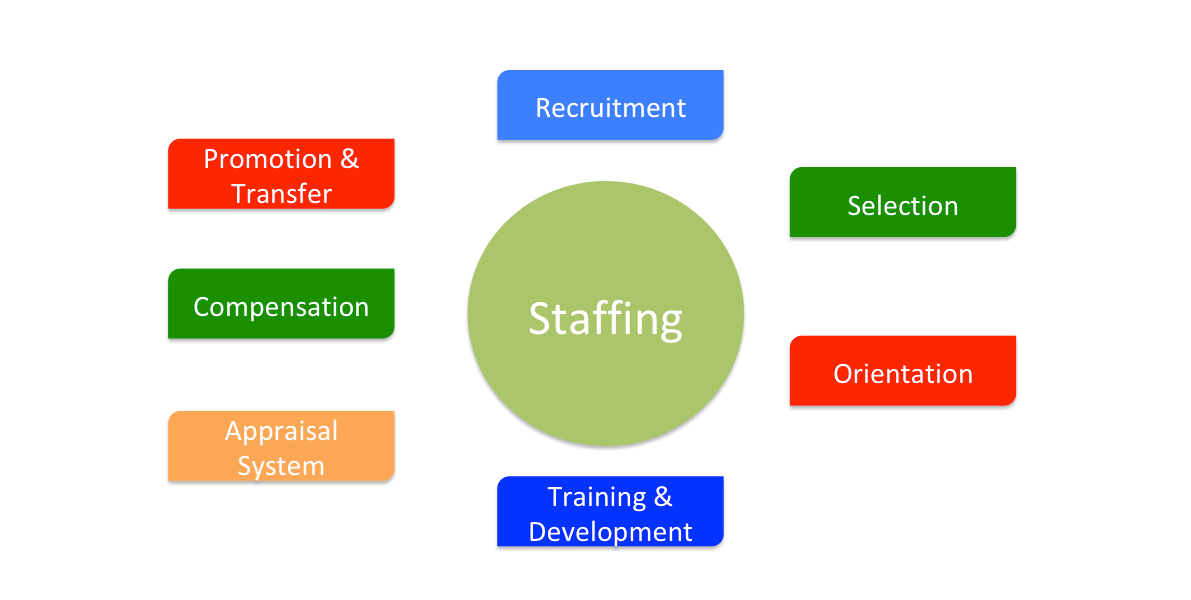
Thus, the various steps involved in the process of staffing are:
- Manpower Planning
- Job Analysis
- Recruitment
- Selection
- Placement
- Induction
- Training and Development
- Performance Appraisal
- Compensation
- Promotion and Transfer
1. Manpower Planning
Manpower planning refers to the process of estimating the manpower requirement of an organisation. While estimating the manpower requirement, the management generally keeps in mind the available infrastructure including the technology, production schedule, market fluctuation, demand forecasts, government’s policies and so on. It tentatively decides the kinds of staff as well as the number of staff needed for the organisation. The focus of manpower planning is to get the right number of qualified people at the right time.
Example: A tech company planning to launch AI products forecasts a need for 200 new software engineers with AI expertise in the next two years.
2. Job Analysis
In the context of recruitment, one must be conversant with another important aspect of manpower planning viz, job analysis, which is a prerequisite for any recruitment exercise. The job analysis helps in determining the qualifications, skills and experience required for various categories of employees. It involves:
- identification of each job in terms of duties and responsibilities (job description)
- determining the abilities and skills that are required for performing the job (job specification)
These two aspects of job analysis (job description and job specification) are useful in the recruitment and selection of employees to find the right person for the job.
3. Recruitment
This stage involves attracting potential candidates. Recruitment can be internal (promotions, transfers) or external (job portals, social media, campus hiring).
The term recruitment is often used to signify employment. As a part of the staffing in HRM function, the term recruitment has limited scope. It just refers to one of the initial steps in the employment of people i.e., searching for suitable candidates for the various job positions to be filled up from time to time in the organisation. Thus, recruitment is the process of finding and attracting suitable applicants for employment.
4. Selection
When an adequate number of applications/names of interested candidates have been collected through the recruitment exercises the selection process starts. Selection refers to the process of choosing the most suitable person from among the list of interested candidates. It involves going through the qualification and experience of all candidates and matching them with the expectation for the job to decide on the most suitable ones for the job.
5. Placement
If the selected candidate decides to join the organisation, they must report to the concerned authority and formally join the organisation by giving their consent in writing. Then they are placed to perform a specific job. Thus, placement refers to the selected candidate joining the positions in the organisation for which they have been selected. The appointment of every candidate is followed by a record of particulars of employment. Such records are properly maintained and are described as employment records. They serve a useful purpose on many occasions like the selection of employees for training, promotion, increments etc.
6. Induction
Induction is the process of introducing new employees to the organisation. The new employees should know under whom and with whom they will work, get acquainted and adjusted to the work environment, and get a general idea about the rules and regulations and working conditions, etc. Usually, the immediate supervisor of a new employee introduces them to the work environment. A proper induction programme is likely to reduce new employees’ anxiety on coping with the work and becoming a part of the organisation and can help in the development of a favourable attitude towards the organisation and the job.
7. Training and Development
Helping employees to improve their knowledge and skill so they can perform their tasks more efficiently is known as training. It is an organised activity for increasing the knowledge and skills of people for a specific purpose. The term ‘development’ refers to the process of not only building up the skill and abilities for specific purposes but also the overall competence of employees to undertake more challenging tasks. It is generally used regarding the training of managers and executives.
Training is necessary for new employees as well as the existing employees for improving their performance at work. For new employees, training is necessary to help them get acquainted with the method of operation and skill requirement of the job. For existing employees, training at periodical intervals helps them learn better ways of doing the work, and also as and when they have to undertake new jobs.
Thus, training helps employees to improve their knowledge and skill and make them perform their tasks more efficiently. It also helps them in the promotion and improves their attitudes and confidence levels in staffing in HRM.
8. Performance Appraisal
In simple words, performance appraisal means judging the performance of employees. Specifically, it means judging the relative abilities of employees at work systematically. This enables managers to identify employees who are performing the assigned work satisfactorily, and those who are not able to do so, and why. To be fair, performance appraisal needs to be carried out using the same methods and keeping in view uniform standards of work.
Generally, it is the responsibility of supervisors to carry out performance appraisals of their subordinates and report them to their superiors. They may also have to identify the causes of the performance, especially if it has fallen short of the expected performance. The standard of performance or the expected level of performance of an employee on a job forms the basis of judging how well the employee has performed, and whether one employee is more efficient than the other in doing a similar job.
9. Compensation
Compensation is one of the most important factors influencing relations between management and the workers. No organisation can attract and retain qualified employees without offering them fair compensation. The term ‘compensation’ refers to a wide range of financial and non-financial rewards to the employees for services rendered to the organisation. It includes wages, salaries, allowances and other benefits which an employer pays to his employees in consideration for their services.
Compensation may be divided into two categories:
- Base/primary compensation: Base or primary compensation is a fixed amount paid every month to an employee. It includes wages, salary and allowances paid to an employee irrespective of his performance.
- Supplementary compensation: Supplementary compensation refers to the compensation paid to the employees to motivate them to work more It is also known as incentive compensation. The incentives may be monetary or non-monetary. The monetary incentives include bonuses, commission sales, or profit-sharing plans. The non-monetary incentives, on the other hand, include cordial relations with the supervisor, assignment of challenging jobs, recognition etc. Such incentives help the employees to sustain interest in the job and motivate them to work hard. They also provide job satisfaction.
10. Promotion and Transfer
When an employee is assigned a job involving greater responsibilities, more pay, higher status and prestige than his/her present job, it is known as promotion. Thus, promotion refers to the advancement of an employee to a higher level or position. The main purpose of promotion is to make fuller use of the abilities of a person and also increase his job satisfaction. The basis of promotion may be seniority in service or merit, that is, superior abilities of the employees, or it may be seniority and merit, that is, merits being the same, one who is senior, is considered for promotion.
When the performance of an employee is not satisfactory and it cannot be improved, he may be assigned a job of lower rank carrying lower status and pay. This is known as ‘demotion’. Transfer refers to a type of job change where any employee is assigned a different job of the same rank and pay, or when an employee is assigned a similar job in another unit of the firm. Thus, transfers do not usually involve any increase in pay or superior status. It may be done simply to enable the employee to gain wider experience, or to give them greater job satisfaction, or to balance the requirements of staff in different units.
Nature of Staffing in HRM
The nature of staffing in HRM can be understood from these points:
-
Continuous: Organizations constantly hire, train, and promote employees.
-
Universal: Every type of organization—businesses, NGOs, and government bodies—needs staffing.
-
Goal-Oriented: Aligns employee contribution with business objectives.
-
Dynamic: Staffing changes as per technological advancements and market shifts.
Staffing vs Recruitment
It is common to confuse staffing with recruitment, but there is a major difference.
| Aspect | Recruitment | Staffing |
|---|---|---|
| Meaning | Attracting candidates to apply for jobs | Comprehensive process of hiring, training, and retaining employees |
| Scope | Narrow – limited to job vacancies | Broad – covers the entire employee lifecycle |
| Focus | Filling positions quickly | Long-term workforce planning |
| Outcome | Short-term fix | Sustainable employee development |
Modern Approaches to Staffing in HRM
Today’s businesses face new challenges, requiring innovative staffing in HRM approaches:
-
Data-Driven Recruitment – Using AI and analytics to find the best candidates.
-
Employer Branding – Attracting talent by building a strong company image.
-
Flexible Workforce Models – Freelancers, gig workers, and remote staff.
-
Diversity & Inclusion – Ensuring equal opportunities for all.
-
Technology Integration – Using HR software for recruitment and employee management.
Challenges in Staffing in HRM
Despite its importance, staffing in HRM comes with challenges:
-
Skill Gaps – Shortage of qualified candidates.
-
High Turnover – Employees leaving for better opportunities.
-
Retention Issues – Keeping top talent is tough in competitive industries.
-
Changing Technology – Constant need for reskilling employees.
-
Cultural Fit Problems – Employees struggling to adapt to workplace culture.
Case Study: Effective Staffing at Google
Google is known for its strong staffing in HRM strategies. By focusing on:
-
Innovative recruitment (campus hiring, online tests),
-
Employee engagement (work-life balance, perks), and
-
Continuous learning (upskilling programs),
Google has consistently ranked as one of the best places to work. Its staffing strategy ensures the right mix of talent, innovation, and employee satisfaction.

Conclusion
Staffing in HRM is more than just hiring people—it is about building a workforce that can drive organizational success. It includes planning manpower, recruiting the right talent, training employees, evaluating performance, and retaining them for long-term growth.
In today’s dynamic world, effective staffing ensures that organizations remain competitive, innovative, and sustainable. A company that invests in staffing builds not just a team, but a community of motivated individuals who help achieve business goals.
In short, staffing in HRM is the backbone of organizational success.
FAQs on Staffing in HRM
Q1. What is staffing in HRM?
Staffing in HRM is the process of hiring, training, and retaining employees to ensure organizational success.
Q2. Why is staffing in HRM important?
It ensures the right person is in the right role, improves productivity, and supports employee development.
Q3. What are the main functions of staffing in HRM?
Manpower planning, recruitment, selection, training, performance appraisal, and career growth.
Q4. How is staffing in HRM different from recruitment?
Recruitment is only about attracting candidates, while staffing is a broader process covering the full employee lifecycle.
Q5. What challenges does staffing in HRM face today?
Talent shortages, high turnover, retention difficulties, and adapting to technological changes.