Introduction to Staffing Models
In today’s fast-paced and competitive business environment, staffing models play a critical role in shaping organizational success. Whether a company is a small startup, a growing mid-sized business, or a global enterprise, choosing the right staffing model can make the difference between achieving goals efficiently or struggling with workforce challenges.
A staffing model refers to a structured plan or framework that organizations use to determine the number of employees, their roles, skills, and work schedules required to meet business objectives. By aligning workforce planning with organizational strategy, staffing models ensure that the right people are in the right roles at the right time.
This comprehensive blog post aims to provide a detailed guide on staffing models, covering everything from definitions and types to industry-specific examples and best practices. Whether you are an HR professional, a business owner, or a manager responsible for workforce planning, this post will equip you with the knowledge and tools necessary to develop and implement effective staffing models tailored to your organization’s unique needs.
What is a Staffing Model?
A staffing model is essentially a blueprint that outlines how a company recruits, deploys, manages, and retains employees to optimize business performance. It considers factors like workload, employee skills, productivity requirements, budgets, and compliance regulations.
Companies use different staffing models depending on their industry, size, and operational needs. For example, a hospital may use a shift-based staffing model to ensure round-the-clock care, while a tech company might adopt a hybrid staffing model that mixes full-time employees with freelance specialists.
Staffing models help organizations to:
Staffing models are more than just a hiring framework — they act as a strategic tool for workforce planning. They help organizations in several important ways:
-
Determine Workforce Size – Identify the ideal number of employees needed to meet current and future business demands.
-
Define Skills and Experience – Clarify the qualifications, knowledge, and expertise required for each role.
-
Optimize Resource Allocation – Ensure employees are deployed effectively to maximize productivity while minimizing costs.
-
Support Future Planning – Anticipate staffing needs based on projected growth, industry trends, and business changes.
-
Maintain Compliance – Ensure adherence to labor laws, industry standards, and regulatory requirements related to staffing.
Importance of Staffing Models
Choosing the right staffing model is not just about filling positions. It directly impacts:
-
Business Productivity – Adequate staffing prevents burnout and ensures workloads are evenly distributed.
-
Employee Satisfaction – When employees feel supported with balanced workloads, job satisfaction increases.
-
Cost Efficiency – Proper staffing avoids overstaffing (leading to high labor costs) and understaffing (causing delays and poor service).
-
Strategic Growth – With the right staffing model, organizations can adapt quickly to market changes and scale efficiently.
-
Compliance – Staffing models ensure adherence to labor laws, industry standards, and organizational policies.
Related:staffing in hrm
Types of Staffing Models
Different industries and organizations adopt different staffing models based on their requirements. Below are the most common types:
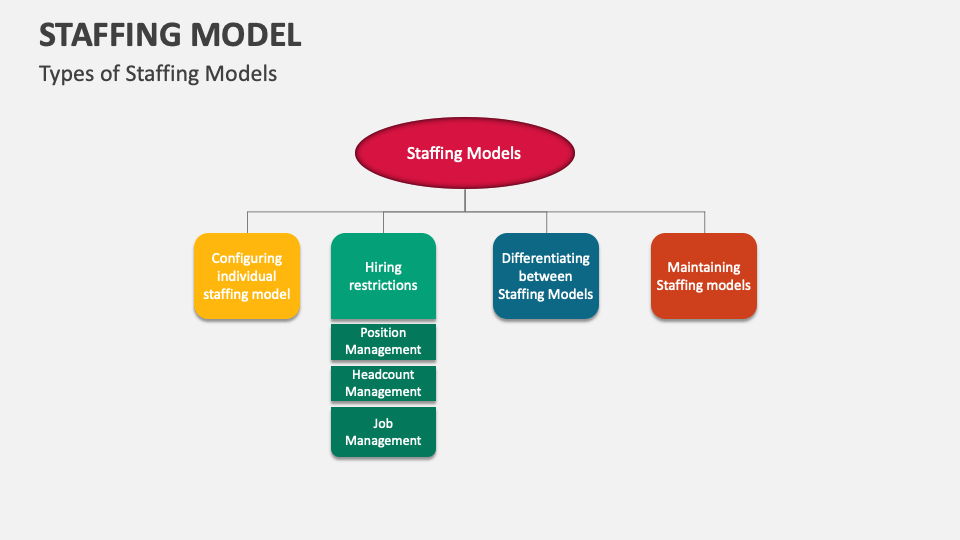
1. Full-Time Staffing Model
This is the most traditional staffing model, where employees are hired on a full-time basis with fixed working hours, benefits, and long-term contracts.
-
Best For: Organizations needing stable, long-term employees.
-
Advantages: Job security, loyalty, consistent productivity.
-
Challenges: High labor costs, limited flexibility.
2. Part-Time Staffing Model
In this model, employees work fewer hours compared to full-time staff, often without full benefits.
-
Best For: Businesses with fluctuating workloads, such as retail or hospitality.
-
Advantages: Cost savings, flexibility in schedules.
-
Challenges: Limited availability of workers, lower employee loyalty.
3. Temporary Staffing Model
Temporary workers (temps) are hired for a short-term project or seasonal need, usually through staffing agencies.
-
Best For: Seasonal industries like e-commerce, tourism, and agriculture.
-
Advantages: Quick hiring, workforce flexibility, reduced liability.
-
Challenges: Lack of long-term commitment, training costs.
4. Contract Staffing Model
Employees are hired on fixed contracts (3 months, 6 months, 1 year) with specific terms.
-
Best For: IT projects, consulting, or industries requiring specialized skills.
-
Advantages: Flexibility, project-based expertise.
-
Challenges: Limited retention, higher hourly costs.
5. Outsourcing Staffing Model
Organizations outsource certain functions to third-party vendors or offshore teams.
-
Best For: Non-core functions like payroll, customer support, or IT services.
-
Advantages: Cost savings, access to expertise, scalability.
-
Challenges: Quality control, communication barriers.
6. Hybrid Staffing Model
A combination of full-time employees, part-time staff, freelancers, and contractors.
-
Best For: Businesses needing flexibility and innovation.
-
Advantages: Diverse skills, adaptability, cost efficiency.
-
Challenges: Coordination issues, cultural differences.
7. Shift-Based Staffing Model
Common in healthcare, manufacturing, and BPOs, where employees work in shifts to ensure 24/7 operations.
-
Best For: Industries needing continuous operations.
-
Advantages: Round-the-clock productivity.
-
Challenges: Employee fatigue, scheduling complexity.
8. Remote Staffing Model
A growing trend where employees work from home or remote locations, supported by digital collaboration tools.
-
Best For: IT, marketing, consulting, and startups.
-
Advantages: Global talent access, reduced infrastructure costs.
-
Challenges: Communication issues, cybersecurity concerns.
9. On-Demand or Gig Staffing Model
Freelancers or gig workers are hired for specific tasks, often through platforms like Upwork or Fiverr.
-
Best For: Short-term projects, creative work, or startups.
-
Advantages: Cost flexibility, specialized skills.
-
Challenges: Inconsistent quality, lack of loyalty.
Five Models Depicting Elements of Staffing
- Staffing Quantity: The quantity or head-count portion of the staffing definition means organizations must be concerned about staffing levels and their adequacy. The organization as a whole, as well as each of its units, forecasts workforce quantity requirements (the needed headcount) and then compares these to forecasted workforce availability (the likely employee headcount) to determine its likely staffing level If head-count requirements match availability, the projection is that the organization will be fully staffed. If requirements exceed availability, the organization will be understaffed, and if availability exceeds requirements, the organization will be overstaffed.
- Person/Job Match: The person/job match seeks to align characteristics of individuals and jobs in ways that will result in desired HR outcomes in staffing models. Casual comments made about applicants often reflect upon the awareness of the importance of the person/ job match. Four key features of the person/job match model are:
- Jobs are characterized by their requirements (e.g., interpersonal skills, previous budgeting experience) and embedded rewards (e.g., commission sales plan, challenge and autonomy).
- Individuals are characterized by their level of qualification (e.g., few interpersonal skills, extensive budgeting experience) and motivation (e.g., need for pay to depend on performance, need for challenge and autonomy).
- In each of the previous examples, the issue was the likely degree of fit or match between the characteristics of the job and the person
- There are implied consequences for every match.
- Person/Organization Match: Often the organization seeks to determine how well a new hire fits or matches not only in their role but also the organization overall. Likewise, applicants often assess how well they think they might fit into the organization, in addition to how well they match the job’s specific requirements and rewards. For both the organization and the applicant, therefore, there may be a concern with a person/organization match. The person/job match is the focal point of staffing, and the job is like the bull’s-eye of the matching target. Four other matching concerns involving the broader organization also arise in staffing. These concern organizational values, new job duties, multiple jobs, and future jobs.
- Staffing System Components: Staffing encompasses managing the flows of people into and within an organization, as well as retaining The core staffing process has several components that represent steps and activities that occur throughout these flows.Staffing begins with a joint interaction between the applicant and the organization. The applicant seeks the organization and job opportunities within it, and the organization seeks applicants for job vacancies it has or anticipates having. Both the applicant and the organization are thus involved as “players” in the staffing process from the very beginning, and they remain joint participants throughout the process.
- Staffing Organizations: In the overall staffing organizations model, an organization’s mission, goals and objectives drive both organization strategy and the HR and staffing The two further interact with each other when they are being formulated. Staffing policies and programs result from such interaction and serve as an overlay to both support activities and core staffing activities. Employee retention and staffing system management concerns cut across this support and core staffing activities. Finally, it should be remembered that staffing levels and staffing quality are the key focal points of staffing strategy, policy, and programs.
Read more: staffing models
Factors to Consider When Choosing a Staffing Model
Selecting the right staffing model depends on:
-
Business Needs – Long-term vs. short-term requirements.
-
Budget – Labor costs, benefits, and overhead expenses.
-
Industry Type – Healthcare requires shift-based models, while IT may prefer hybrid or remote staffing.
-
Skill Availability – Highly specialized skills may be more accessible through contract or gig staffing.
-
Scalability – The ability to expand or reduce workforce easily.
-
Compliance Requirements – Labor laws, tax regulations, and employee rights.
Benefits of Using Staffing Models
Implementing the right staffing model brings multiple advantages:
-
Improved workforce planning
-
Better employee engagement
-
Cost management
-
Enhanced service delivery
-
Higher productivity
-
Business agility
Challenges in Staffing Models
Even with the best planning, organizations face challenges such as:
-
Skill shortages in the labor market
-
High turnover rates in part-time or contract models
-
Compliance complexities across regions
-
Training costs for temporary or contract workers
-
Balancing flexibility with consistency
Best Practices for Effective Staffing Models
-
Regular Workforce Analysis – Evaluate demand and supply gaps.
-
Technology Integration – Use HR software, AI, and analytics to optimize staffing.
-
Employee Training & Development – Upskill employees to adapt to changing models.
-
Diversity & Inclusion – Build diverse teams to strengthen performance.
-
Scalable Staffing Strategy – Plan for growth, seasonal peaks, and emergencies.
-
Feedback Systems – Gather employee input to refine staffing strategies.
Staffing Models in Different Industries
-
Healthcare: Shift-based and hybrid staffing models.
-
IT & Tech: Contract, remote, and hybrid models.
-
Retail & Hospitality: Part-time and seasonal staffing models.
-
Manufacturing: Shift-based and full-time models.
-
Startups: Gig, contract, and hybrid staffing models.
Future of Staffing Models
The future of staffing models is expected to be shaped by:
-
AI and automation in workforce planning.
-
Increased adoption of hybrid and remote staffing.
-
Rising gig economy and freelance workforce.
-
Greater focus on employee well-being and work-life balance.
-
Data-driven staffing decisions using predictive analytics.
Examples of Staffing Models
1. Full-Time Staffing Model
-
Example: A bank employs full-time tellers, managers, and clerks who work 8 hours a day, 5–6 days a week.
-
Why: Banking requires permanent staff for daily operations and customer trust.
2. Part-Time Staffing Model
-
Example: A retail store hires part-time sales associates who work evenings and weekends.
-
Why: This helps the store manage costs while handling peak customer hours.
3. Temporary Staffing Model
-
Example: An e-commerce company hires extra warehouse workers during the holiday season.
-
Why: To meet seasonal demand without long-term hiring commitments.
4. Contract Staffing Model
-
Example: An IT company hires a cybersecurity expert on a 6-month contract for a specific project.
-
Why: To access specialized skills without keeping the employee permanently.
5. Shift-Based Staffing Model
-
Example: A hospital employs nurses and doctors in rotating shifts (day, night, weekend).
-
Why: To provide 24/7 patient care.
6. Outsourcing Staffing Model
-
Example: A company outsources payroll processing to an external HR agency.
-
Why: To reduce workload and costs while focusing on core business.
7. Remote Staffing Model
-
Example: A digital marketing firm hires graphic designers who work from home in different cities.
-
Why: To access global talent and cut office expenses.
8. On-Demand or Gig Staffing Model
-
Example: A startup hires freelance content writers through Upwork or Fiverr for blog projects.
-
Why: To get skilled professionals for short-term tasks.
Industry-Specific Staffing Models
Different industries have unique workforce needs. That’s why organizations adopt industry-specific staffing models to balance efficiency, costs, and flexibility. Here’s how staffing models vary across sectors:
Healthcare Industry
-
Staffing Models Used: Shift-Based Staffing, Contract Staffing, Per Diem Staffing
-
Example: Hospitals hire full-time doctors (core staff) but rely on per diem nurses and shift-based rotations to provide 24/7 patient care.
-
Why: Continuous operations and emergency readiness require flexibility.
2. Information Technology (IT) Industry
-
Staffing Models Used: Contract Staffing, Remote Staffing, Hybrid Staffing
-
Example: An IT company hires developers full-time, cybersecurity experts on contracts, and remote freelancers for specific projects.
-
Why: IT projects demand specialized skills, scalability, and global talent access.
3. Retail Industry
-
Staffing Models Used: Part-Time Staffing, Temporary Staffing, Seasonal Staffing
-
Example: Stores keep permanent managers but hire part-time and temporary workers during holiday seasons.
-
Why: Customer demand peaks during weekends, festivals, and sales seasons.
4. Hospitality Industry
-
Staffing Models Used: Part-Time Staffing, Seasonal Staffing, Outsourcing
-
Example: Hotels employ core staff (chefs, managers) but hire temporary staff during tourist seasons. Some outsource housekeeping services.
-
Why: Tourism is seasonal, so flexible staffing saves costs.
5. Manufacturing Industry
-
Staffing Models Used: Shift-Based Staffing, Full-Time Staffing, Contract Staffing
-
Example: Factories employ full-time operators and use rotating shifts. Specialized engineers are hired on contract.
-
Why: Manufacturing runs 24/7, requiring both stability and flexibility.
6. Education Industry
-
Staffing Models Used: Full-Time Staffing, Part-Time Staffing, Adjunct Staffing
-
Example: Schools employ full-time teachers but also hire part-time tutors or adjunct faculty for specific subjects.
-
Why: To balance permanent academic staff with experts in specialized fields.
7. E-Commerce Industry
-
Staffing Models Used: Temporary Staffing, Outsourcing, Remote Staffing
-
Example: An online store hires temporary warehouse workers during sales events and outsources customer service to call centers.
-
Why: Seasonal demand and cost efficiency drive staffing flexibility.
8. Business Process Outsourcing (BPO) Industry
-
Staffing Models Used: Shift-Based Staffing, Contract Staffing, Remote Staffing
-
Example: A call center runs 24/7 using rotating shifts, with seasonal contracts for new client projects.
-
Why: BPOs handle global clients across time zones, requiring scalable staffing.
9. Construction Industry
-
Staffing Models Used: Contract Staffing, Project-Based Staffing, Outsourcing
-
Example: Construction firms keep core engineers and project managers but hire contract laborers for specific building projects.
-
Why: Projects are temporary, requiring flexible labor.
10. Startups
-
Staffing Models Used: Hybrid Staffing, Gig Staffing, Remote Staffing
-
Example: A startup has a small full-time core team but relies on freelancers for design, marketing, or app development.
-
Why: Cost-saving and access to diverse expertise.
✅ Each industry selects a staffing model that matches its workload, customer needs, and business strategy.
Conclusion
Staffing models are the backbone of workforce planning and directly influence business success. By carefully selecting the right model, organizations can achieve cost efficiency, improve productivity, and remain competitive in an ever-changing market.
Whether it’s full-time, part-time, contract, or hybrid staffing, the key is to align staffing decisions with organizational goals, employee needs, and industry trends. Businesses that master staffing models will not only optimize resources but also build a future-ready workforce.
FAQs on Staffing Models
Q1: What is the most common staffing model?
Full-time staffing remains the most common, but hybrid and remote models are rapidly growing.
Q2: Which staffing model is best for startups?
Hybrid and gig staffing models are ideal due to flexibility and cost efficiency.
Q3: How do staffing models affect employee productivity?
The right model ensures balanced workloads, reducing stress and increasing performance.
Q4: Are staffing models industry-specific?
Yes, industries like healthcare need shift-based models, while IT may prefer hybrid or contract models.
Q5: Can staffing models change over time?
Absolutely. Businesses should adjust staffing models as they grow or