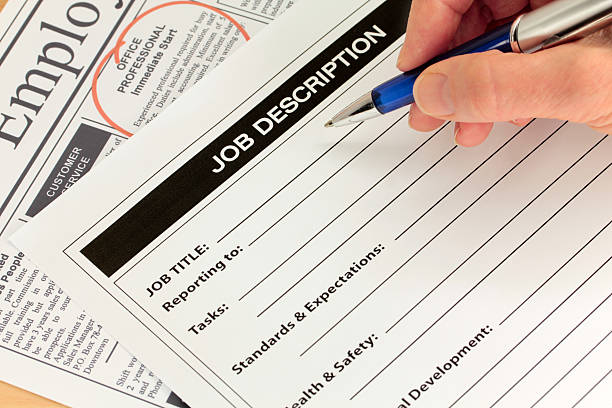
In Human Resource Management, a Job Description plays a vital role in hiring and employee management. It defines what a role demands, the skills required, and how it contributes to organizational goals. A well-crafted Job Description helps recruiters attract the right candidates and helps employees clearly understand their responsibilities.
This complete guide will walk you through the meaning, purpose, elements, benefits, and examples of a job description — plus, how to write one effectively for your organization.
Job Description: is a written record of the duties, responsibilities and requirements of a particular job. It is concerned with the job itself and not with the job holders. A model job design includes the title of the job, information about duties, responsibilities, facilities, pay scale, location, working conditions and hazards, etc. Job descriptions usually have a label, called a “job title,” and a section describing the qualifications needed to perform the job. These qualifications are encoded as job specifications.
Job Description as, “A job description is an organized, factual statement of duties and responsibilities of a specific job. In brief, it should tell what is to be done. How it is done why. It is a standard of function, in that defines the appropriate and authorized content of a job.
“Job description is a pertinent picture (in writing) of the organizational relationships, responsibilities and specific duties that constitutes a given job or position. It defines a scope of responsibility and continuing work assignments that are sufficiently different form that of other jobs to warrant a specific title.”
. A job description helps us in:
- Job grading and classification
- Transfers and
- Adjustments of grievances;
- Defining and outlining promotional steps:
- Establishing a common understanding of a job between employers and employees;
- Investigation accidents ;
- Indicating faulty work procedures or duplication of papers;
- Maintaining, operating and adjusting machinery;
- Time and motion studies;
- Defining the limits of authority;
- Indicating case of personal merit;
- Studies of health and fatigue;
- Scientific guidance;
- Determining jobs suitable for occupational therapy;
- Providing hiring specifications; and
- Providing performance
Job descriptions focus on primary duties and responsibilities of the position and not incidental duties. Related or similar duties are combined and written as one statement.
Purpose of Job Description
According to Wendell French (1995), a job description is useful for the following processes
- of personnel administration: –
- Recruiting, interviewing, and
- Orientation and training
- Setting performance standards and / or goal statements
- Designing performance appraisal forms
- Job evaluation
- Clarification and renegotiation of roles
- Career progression ladders
Advantages of a Job Description
Role specificity and clarity are provided for. As a corollary, role ambiguity is avoided and organisational processes are simplified. Consequently, job descriptions, as a management tool can greatly simplify an organisation’s human resource management function. Job descriptions clarify work content, helping employees understand their work better and employers, institute performance appraisal and development process, maneuver job design for job rotation, enrichment(vertical loading), and enlargement(horizontal loading) exercises for overall performance improvement and organisational effectiveness.
The focus is on job outcomes, which makes job description a result oriented exercise. It helps lay down what is expected of a job in terms of all logistical, and behavioural (training, supervision) requirements so that they can be secured with proper lead time.
Cost effectiveness and time management at work are the two important considerations in a job description exercise.
Work study and method study are applied on the basis of job descriptions. Core areas for procedural reform can be easily identified and procedural improvements brought about. The effect of procedural innovations, if any, is examined easily. The worker can be rewarded for successful innovations.
Job descriptions aid in maintaining a consistent salary structure. It leads to job evaluation, which is used specifically for compensation administration.
Disadvantages of Job Description
While a Job Description is an essential HR tool that provides clarity and structure in recruitment and performance management, it also comes with certain limitations and disadvantages.
A poorly written or outdated job description can cause confusion, restrict flexibility, and negatively impact both employees and the organization.
Let’s look at the major disadvantages of a Job Description in detail
1. Limits Employee Flexibility
A detailed Job Description can sometimes make employees feel restricted to performing only the tasks mentioned in their job role.
If the organization needs them to take on new responsibilities or adapt to changing work conditions, they may resist by saying, “It’s not in my job description.”
Example:
If a marketing executive is asked to help with customer relations but the job description doesn’t mention it, they may feel it’s beyond their role.
Result: Reduces teamwork and adaptability in dynamic workplaces.
2. Becomes Outdated Quickly
In today’s fast-changing business environment, job roles evolve rapidly due to new technologies, digital tools, and shifting strategies.
If HR doesn’t update the Job Description regularly, it becomes irrelevant or inaccurate.
Example:
A “Social Media Executive” role written in 2019 may not include skills like AI content creation or influencer outreach, which are essential today.
Result: Misleading information during recruitment and performance evaluation.
3. Can Create Role Conflicts
Sometimes, two employees’ job descriptions may overlap, leading to confusion about responsibilities.
When boundaries aren’t clearly defined, both might assume or reject the same tasks.
Example:
Both an HR Executive and Admin Officer might have “employee engagement” listed in their duties, leading to confusion.
Result: Workplace conflicts and reduced accountability.
4. Discourages Creativity and Initiative
A strict Job Description can make employees focus only on assigned duties, discouraging innovation or extra effort.
They might hesitate to suggest improvements or take initiative beyond their written tasks.
Example:
A customer service executive may have creative ideas for marketing, but if it’s not part of their Job Description, they may not share them.
Result: Limits employee motivation and organizational growth.
5. Overemphasis on Written Duties
Some organizations rely too heavily on Job Descriptions for evaluating performance or assigning responsibilities.
This can lead to a rigid system where employees focus on “checking boxes” instead of achieving real results.
Result: Performance is measured by tasks, not outcomes.
Key Components of a Job Description
A professional Job Description usually includes the following elements:
1. Job Title
Clearly states the name of the position. It should be specific, not vague.
Example:
-
HR Intern
-
Marketing Executive
-
Sales Manager
2. Job Summary
A short paragraph describing the job’s purpose and overall objectives.
Example:
The HR Executive supports daily HR operations, recruitment, and employee relations activities to ensure smooth business functioning.