Designing training programs is a crucial function of human resource management that focuses on enhancing employees’ skills, knowledge, and overall performance. In today’s competitive business environment, organizations cannot rely only on hiring talented employees; they must continuously invest in well-structured training programs to achieve long-term success. Effective training design ensures that employees are equipped with the right competencies to meet organizational goals and adapt to changing workplace demands.
In human resource management, designing training programs involves identifying training needs, setting clear learning objectives, selecting appropriate training methods, and evaluating training outcomes. A well-designed training program not only improves employee efficiency and productivity but also increases job satisfaction and retention. When training is aligned with organizational strategies, it becomes a powerful tool for employee development and organizational growth.
This complete guide on Designing Training in Human Resource Management explains the meaning, importance, process, and key elements involved in designing effective training programs. It will help students, HR professionals, and beginners understand how training programs are planned and implemented to support both employee development and organizational success.

Concept of Designing Training Programs
“Training design is responsible for defining the instructional objectives, sequencing training materials, applying learning concepts, and developing effective training techniques.”
Training and orientation are provided to all new staff. But what about the employees who have been a part of your team for years and who, like you, want the opportunity to learn and grow? Designing training programes and educational courses and lessons for your existing staff is a part of the training design process.
When a corporation designs its training, it is able to examine its requirements planning, developing, and organizing training programs to improve employees’ knowledge, skills, abilities, and attitudes required for effective job performance. In human resource management, designing training programs ensures that learning activities are aligned with organizational goals as well as individual employee needs.
Designing training begins with identifying training needs through job analysis and performance gaps. Based on these needs, clear training objectives are set to define what employees are expected to learn after the training program. The next step involves selecting appropriate training methods, content, and learning materials that suit the nature of the job and the learning capabilities of employees.
An effective training design focuses on learner-centered approaches, practical applicability, and measurable outcomes. It considers factors such as learning styles, duration of training, available resources, and evaluation methods. Properly designed training programs help organizations improve productivity, enhance employee performance, reduce errors, and prepare employees for future roles and responsibilities.
In short, the concept of designing training emphasizes a structured and strategic approach to employee development, ensuring that training programs are meaningful, cost-effective, and capable of delivering desired results for both employees and the organization.
Process of Designing Training Programs
Design Process of Training
The design process of training refers to a systematic series of steps followed to create effective and result-oriented training programs. This process ensures that training activities are well planned, aligned with organizational objectives, and capable of improving employee performance.
Process of Designing Training Programs: Steps 1, 2 and 3
Step 1: Assess your training requirements.
There are only four stages to evaluating a training programme:
- Identifying the business goal that a training programme can help to achieve: The goal of training should be clear and encouraging. Increasing ROI and lowering expenses are some examples of aims, as are educating staff a new method or showing them how to utilise new technology.
- Identifying the duties that employees should complete in order for the firm to achieve its objectives:
- Compare what your staff are doing today with what they will need to accomplish in the future to reach the goals. If a new product is being released, for example, staff will need to know what the product is, how to create it, and any other important aspects in order for the launch to be successful.
- Conducting training exercises that will assist in the employees’ learning and ability to complete duties more efficiently:
When you know what your workers need to learn, you can start planning activities like demos, booklets, and hands-on exercises to help them learn.
- Identifying the employees’ learning characteristics to ensure that the training is effective:
Use that information to make the training as successful as possible by tailoring it to the needs of as many employees as feasible. This might imply that your contents and delivery are based on the top two or three most common learning techniques used by your staff.
Steps 2: Adults should be taught like adults
- In keeping with the last section of step one, it’s crucial to realise that your employees are
- adults with unique traits that might make it easier or more difficult for them to learn under different teaching approaches to succeed. Adult learning elements to take in mind while building your training programme include those listed below:
- Adults desire to be recognised and accepted for who they are.
- These individuals have a great deal of previous information, experience, and autonomous viewpoints.
- They have a strong sense of direction and are self-motivated.
- This group expects their training to be relevant, task-oriented, and worthwhile of the time that it takes away from their everyday output.
- They are interested in learning how they will profit from this course.
These concepts may be readily connected to the traits that you found when you analysed your training requirements, as shown in the following diagram. You should be able to see how these traits will lead you as you design your training programme at this point.
Steps 3: Create a list of learning objectives
● When you think about what you anticipate your staff to be able to perform once they complete training and development you might be surprised. Depending on the situation, knowledge, a skill, or a basic yet necessary competency may be required. These will be the learning objectives that you will be working toward. From there, you can start developing material that will help you move closer to each goal in the process. Maintain the focus of your classes on the objectives and change up the ways you use to assess employees’ recall of the material you’re giving them with.
● Your objectives should be given in the form of SMART goals, which are specific, measurable, achievable, relevant, and time-based goals. Creating objectives in this manner might assist you in ensuring that your staff accomplish critical milestones during their training period.
Models of Designing Training Programs
Models of designing training programs provide a structured framework that helps HR professionals plan, implement, and evaluate effective training initiatives. These models ensure that training programs are systematic, learner-focused, and aligned with organizational goals. Some of the most widely used training design models are discussed below.
1. ADDIE Model
The ADDIE model is one of the most popular models used in designing training programs. It consists of five stages:
-
Analysis – Identifying training needs and learner requirements
-
Design – Defining objectives, content, and training methods
-
Development – Creating training materials and resources
-
Implementation – Delivering the training program
-
Evaluation – Measuring training effectiveness
This model is simple, systematic, and widely used in HR and instructional design.
2. Systematic Training Model
The systematic training model views training as a continuous cycle. It focuses on identifying organizational needs, designing appropriate training interventions, implementing training, and evaluating outcomes. Feedback from evaluation is used to improve future training programs.
3. Instructional System Design (ISD) Model
The Instructional System Design model emphasizes learner needs and learning outcomes. It focuses on breaking down training content into smaller learning units and using suitable instructional strategies to achieve desired performance improvements.
4. Kirkpatrick’s Training Model
Although mainly an evaluation model, Kirkpatrick’s model also supports training design. It evaluates training at four levels:
-
Reaction
-
Learning
-
Behavior
-
Results
This model helps designers ensure that training programs produce measurable and meaningful outcomes.
5. Competency-Based Training Model
The competency-based training model focuses on developing specific skills and competencies required for job roles. Training programs are designed based on job competencies, and employees are evaluated on their ability to demonstrate those competencies in the workplace.
Steps in creating effective Designing training programs
Step 1 – Assess Organisational Training and Development Needs
You have a requirement, and you want the training programme to meet it. It may be a new product that requires a complete overhaul of the manufacturing process, or it could just be some tweaks to boost the output of an existing product. You want staff to grasp and adapt to the new production flow on both counts, increasing their in-line efficiency.
Step 2 – Define Your Training Objective
The business objective has been established. Let’s have a look at how to evaluate the training needs for this aim. You must be certain about the following:
Determine the business objective that the training supports, as well as the roles and responsibilities of your workers in reaching that goal, and the kind of training required to guarantee that they can perform these roles and responsibilities.
As a result, the most crucial component of the programme is identifying this kind of training goal. It provides direction for the programme and also acts as a metric for success. Simply said, the training will be considered effective if your staff are able to do the duties for which they were prepared.
This is required in order for this to occur.
● It must be expressed clearly and make sense to all parties concerned.
● It must be expressed clearly and make sense to all parties concerned.
● It must be attainable; it must be related to the training.
● It must be quantifiable.
Make sure your staff grasp the goals by using examinations, quizzes, and practical tasks to assess their comprehension.
Step 3 – Training Program Design
Prepare a road map for your ideas before putting them into action. A comprehensive strategy that considers learning and instructional techniques, material, content flow, and other factors.
● Design with your workers’ requirements in mind, rather than the trainer’s.
● Always generate information that is relevant to your training goal.
● Adult training techniques were included in the design (see below).
● As many practical sessions as feasible should be included in the curriculum.
● Create an application that is interactive. Q and A sessions should be introduced.
● Break up the sessions into smaller chunks.
● Ensure that the flow is appropriate and that the segments are connected.
Step 4 – Adopt Training Principles for Adults
Keep in mind that you’re planning to train grownups. Their particular learning qualities must be taken into account in the training curriculum. They:
● are experienced, self-motivated, and goal-oriented;
● choose training that will help them grow;
● prefer task-oriented, relevant training programmes;
● take pleasure in their industry expertise, which must be acknowledged.
Step 5 – Training Program Development
Begin creating your training materials, such as training manuals, instructor training notes, PowerPoint presentations, charts, posters, and other resources for hands-on practical sessions.
Step 6 – Training Program Implementation
This is the point at which all of your previous preparation will be put into action. A few things to keep in mind for successful implementation:
● Plan training activities ahead of time and gather the necessary materials.
● Determine the program’s location depending on the size and kind of training rooms required.
Step 7 – Evaluate Your Training Program
This is the last step before you may sit back and relax. Examine the program’s conception and development, its efficacy, and the level of success it has attained.
● Employee Input: Collect feedback from employees on the programme. Was it instructive, useful, or engrossing? Do they have any recommendations for how to improve it? Collecting feedback like this from workers who attend training sessions can aid you in developing new and better programme versions.
● Employee evaluations must be completed throughout training sessions. Assess how much of the instruction the workers truly comprehended. Mini quizzes, practical exercises, and other methods may be used to accomplish this. In a nutshell, you want to make sure they understand the training goal and how to reach it.
● After your taught personnel return to work, undertake an on-the-job review of the training programme to determine its efficacy in accomplishing the goals.
Designing Training Programs Framework
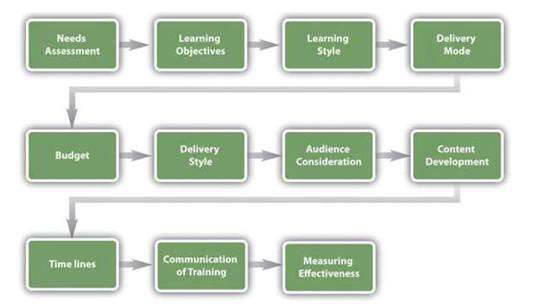
The following are some things to think about while creating a training programme:
● Assessment and learning goals are required. This section of the framework development encourages you to examine what kind of training your company need. You may define learning goals to measure at the conclusion of the course after you’ve decided the training you’ll require.
● Learning styles are taken into account. When developing training programmes, it’s critical to remember to educate to a range of learning styles.
● Mode of delivery. What is the most effective approach to communicate your message? Is web-based training better, or should mentoring be employed instead? Is it possible to utilise vestibule training for part of the training while also doing some work shadowing? A range of delivery modalities will be used in most training programmes.
● Budget. What kind of budget do you have for this training?
● Style of delivery Will the training be self-paced, or will it be conducted by an instructor? In connection with this training, what sorts of dialogues and engagement may be developed?
● Audience. Who will be involved in the training? Do you have a mix of positions, such as accountants and marketers? What are these people’s work duties, and how can you tailor the training to their specific needs?
● Content. What should be taught? How are you going to organise the data?
● Timelines. How long will the training take to develop? Is there a time limit for completing the training?
● Communication. How will workers be informed that training is available?
● Measuring the training’s efficacy. How will you determine whether or not your training was effective? What methods will you use to assess this?
Conclusion: Designing Training Programs
Designing training programs is a strategic and continuous function of human resource management that plays a vital role in enhancing employee performance and organizational effectiveness. A well-designed training program ensures that employees acquire the necessary knowledge, skills, and competencies required to perform their jobs efficiently and adapt to changing business environments.
By following a systematic training design process—starting from training needs assessment, setting SMART learning objectives, selecting suitable training methods, and evaluating outcomes—organizations can ensure that training initiatives are meaningful and result-oriented. Models such as ADDIE, ISD, Kirkpatrick’s Model, and competency-based training provide structured frameworks that help HR professionals design, implement, and improve training programs effectively.
In today’s competitive environment, continuous learning and employee development are essential for organizational growth. Therefore, designing training programs should not be treated as a one-time activity but as an ongoing investment in human capital. When training is aligned with organizational goals and employee needs, it leads to higher productivity, improved job satisfaction, better retention, and long-term organizational success.
Frequently Asked Questions (FAQs)
1. What is designing training programs in HRM?
Designing training programs in HRM refers to the systematic process of planning, developing, and organizing training activities to improve employees’ knowledge, skills, abilities, and job performance in line with organizational goals.
2. Why is designing training programs important?
Designing training programs is important because it helps employees perform their jobs efficiently, reduces performance gaps, increases productivity, improves job satisfaction, and prepares employees for future roles and responsibilities.
3. What are the main steps in designing training programs?
The main steps include training needs assessment, setting learning objectives, designing training content, selecting training methods, implementing the program, and evaluating training effectiveness.
4. What is training needs assessment?
Training needs assessment is the process of identifying gaps between current employee performance and desired performance. It helps determine what type of training is required and who needs it.
5. What are training objectives?
Training objectives are clear statements that describe what employees should learn or be able to do after completing a training program. These objectives are usually written in SMART form—specific, measurable, achievable, relevant, and time-bound.