Salary is one of the most important aspects of employment. Every employee wants to understand how their salary is structured, how deductions are calculated, and how much money they will actually receive in their bank account. In Human Resource Management, this entire system is known as the Salary Structure in HR.
A well-designed Salary Structure in HR helps organizations maintain transparency, ensure legal compliance, and attract talented employees. It also helps HR professionals manage payroll effectively while maintaining fairness in employee compensation.
In modern organizations, salary is not just about basic pay. It includes various components such as allowances, bonuses, benefits, and statutory deductions. Understanding these elements is important for both HR professionals and employees.
In this complete guide, we will explain the Salary Structure in HR, including its components, calculation methods, examples, and best practices used by organizations in 2026.
What is Salary Structure in HR?
The Salary Structure in HR refers to the framework used by organizations to divide an employee’s total compensation into different components such as basic salary, allowances, bonuses, and deductions.
It defines how much an employee earns and how the salary is distributed across different categories. The salary structure helps organizations standardize employee compensation and maintain internal equity.
A typical salary structure includes:
-
Basic Salary
-
Allowances (HRA, conveyance, medical)
-
Bonuses and incentives
-
Statutory benefits (PF, ESI)
-
Deductions such as tax
A properly designed Salary Structure in HR ensures that employees receive fair compensation while organizations remain compliant with labor laws.

Importance of Salary Structure in HR
A well-planned Salary Structure in HR is essential for effective human resource management. It helps organizations maintain a systematic and transparent approach to employee compensation.
1. Transparency in Compensation
A clear salary structure allows employees to understand their earnings and deductions.
2. Legal Compliance
Companies must follow government regulations regarding employee wages, taxes, and benefits. The Salary Structure in HR helps ensure compliance.
3. Employee Satisfaction
Employees feel more satisfied when they clearly understand how their salary is calculated.
4. Better Payroll Management
A structured salary system simplifies payroll processing and reduces calculation errors.
5. Talent Attraction and Retention
Organizations with competitive salary structures are better able to attract and retain skilled professionals.
Key Components of Salary Structure in HR
The components of a salary structure help organizations determine how employees are compensated. A well-designed salary structure ensures transparency, tax efficiency, and legal compliance.
Although salary structures may vary from one company to another, most organizations include several standard components. These components together form the total compensation package offered to employees.
Below are the major components of a Salary Structure in HR.
Related: Compensation Pay model in HR
2. Basic Salary (Basic Pay)
Basic salary is the core component of the salary structure. It is the fixed amount paid to an employee before adding allowances or deducting taxes.
Generally, the basic salary is around 40–45% of the CTC.
Characteristics of Basic Salary
-
Fully taxable
-
Determines other salary components
-
Used to calculate PF, gratuity, and bonuses
-
Fixed amount paid monthly
Example
If an employee’s CTC is ₹6,00,000 per year, the basic salary may be around:
₹2,40,000 – ₹2,70,000 annually
The basic salary depends on factors such as job role, experience, industry standards, and company policy.
2. House Rent Allowance (HRA)
HRA is provided to employees to help cover their housing expenses.
The amount depends on the employee’s salary and the city in which they live.
Typical HRA structure:
-
50% of basic salary for metro cities
-
40% of basic salary for non-metro cities
Example:
Basic Salary = ₹30,000
HRA (50%) = ₹15,000
3. Dearness Allowance (DA)
Dearness Allowance is provided to compensate employees for the impact of inflation.
It is mainly given to government employees and public sector workers.
4. Conveyance Allowance
Conveyance allowance is provided to cover transportation expenses between home and workplace.
Example:
Conveyance Allowance = ₹2,000 per month
5. Medical Allowance
Some organizations provide medical allowance or health insurance benefits to employees.
Example:
Medical Allowance = ₹1,500 per month
6. Special Allowance
Special allowance is a flexible component added to balance the salary structure.
It ensures that the total salary matches the employee’s agreed compensation.
7. Performance Bonus and Incentives
A performance bonus is an additional payment given to employees based on their work performance.
Companies use bonuses and incentives to motivate employees and reward outstanding performance.
Types of Bonuses
-
Annual performance bonus
-
Sales incentives
-
Project completion bonus
-
Profit-sharing bonus
Bonuses may be fixed or variable depending on company policies.
8. Gratuity
Gratuity is a lump-sum payment given to employees who have completed five or more years of service with the organization.
It is applicable to companies with 10 or more employees.
Gratuity is calculated as 4.81% of the employee’s basic salary.
Gratuity Formula
Gratuity = (Last Drawn Salary × 15 × Years of Service) ÷ 26
Example
Last Drawn Salary = ₹30,000
Years of Service = 6
Gratuity = ₹1,03,846 (approx.)
Gratuity acts as a long-term employee benefit and retirement support.
Salary Deductions in Salary Structure in HR
Deductions are amounts subtracted from an employee’s gross salary before calculating the final take-home salary.
1. Provident Fund (PF)
The Employee Provident Fund is a retirement savings scheme where both employer and employee contribute.
Contribution:
Employee Contribution = 12% of Basic Salary
Employer Contribution = 12% of Basic Salary
Example:
Basic Salary = ₹25,000
Employee PF = ₹3,000
Employer PF = ₹3,000
2. Employee State Insurance (ESI)
ESI is a social security scheme providing medical benefits to employees.
Contribution rates:
Employee Contribution = 0.75% of salary
Employer Contribution = 3.25% of salary
Benefits of ESIC
-
Medical treatment
-
Maternity benefits
-
Disability compensation
-
Dependents’ benefits
ESIC ensures social security for lower-income employees.
3. Professional Tax
Professional tax is a tax imposed by state governments on salaried individuals.
Employers deduct professional tax from employees’ salaries and deposit it with the government.
Key Points
-
Maximum professional tax: ₹2,500 per year
-
Deducted monthly from salary
-
Amount varies by state
Professional tax is a mandatory deduction in several Indian states.
4. Income Tax (TDS)
Income Tax or TDS is deducted based on the employee’s taxable income.
Employers must deduct tax according to the Income Tax Act.
Understanding CTC in Salary Structure in HR
CTC stands for Cost to Company. It represents the total amount a company spends on an employee annually.
CTC includes:
-
Basic Salary
-
HRA
-
Allowances
-
Bonuses
-
Employer PF contribution
-
Insurance benefits
Example:
Annual CTC = ₹6,00,000
This does not mean the employee will receive the entire amount as take-home salary.
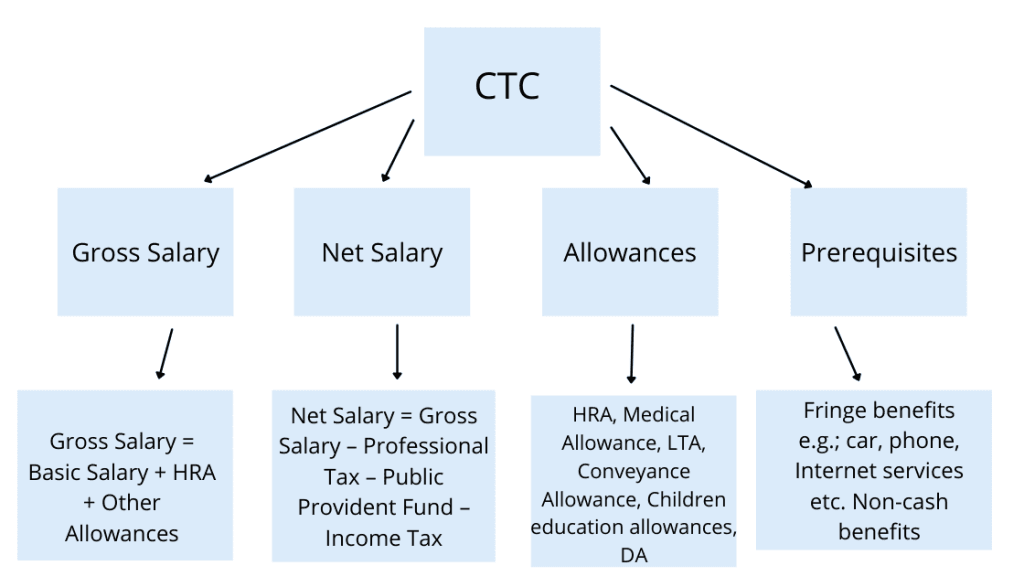
Difference Between CTC, Gross Salary, and Net Salary
Understanding these three concepts is essential when learning about the Salary Structure in HR.
CTC (Cost to Company)
Total cost incurred by the employer.
Example:
CTC = ₹6,00,000 per year
Gross Salary
Total salary before deductions.
Formula:
Gross Salary = Basic Salary + Allowances + Bonuses
Example:
Basic Salary = ₹30,000
HRA = ₹15,000
Special Allowance = ₹5,000
Gross Salary = ₹50,000
Net Salary
Net salary is the final amount received by the employee after deductions.
Formula:
Net Salary = Gross Salary – Deductions
Example of Salary Structure in HR
Let’s understand a complete salary structure example.
Employee Salary Details:
Basic Salary = ₹25,000
HRA = ₹10,000
Special Allowance = ₹5,000
Medical Allowance = ₹2,000
Gross Salary = ₹42,000
Deductions:
PF = ₹3,000
Professional Tax = ₹200
Income Tax = ₹1,000
Total Deductions = ₹4,200
Final Calculation:
Net Salary = ₹42,000 – ₹4,200
Net Salary = ₹37,800
So, the employee receives ₹37,800 as take-home salary.
Types of Salary Structures
Organizations generally use two types of salary structures.
1. Top-Down Salary Structure
In this method, HR professionals determine individual salary components first and then calculate the gross salary.
For example:
Basic Salary + Allowances + Bonuses = Gross Salary
This approach focuses on defining each salary component separately.
2. Bottom-Up Salary Structure
In this method, the gross salary is calculated first, and then different salary components are divided from it.
Example
If gross salary = ₹50,000
Basic Salary = 50% of gross salary
Allowances = 25% of gross salary
Basic Salary = ₹25,000
Allowances = ₹12,500
This method is commonly used in structured payroll systems.
How HR Professionals Design Salary Structure
Designing an effective Salary Structure in HR is one of the most important responsibilities of human resource professionals. A well-designed salary structure ensures that employees are compensated fairly, the organization remains competitive in the job market, and legal compliance is maintained.
1. Job Evaluation
The first step in designing a Salary Structure in HR is job evaluation. Job evaluation is the process of analyzing and determining the relative value of each job role within the organization.
HR professionals study the responsibilities, skills required, experience level, and the impact of the job on the organization. This helps HR understand which roles are more complex or critical to the business.
Key Factors Considered in Job Evaluation
HR teams typically analyze several factors during job evaluation, such as:
-
Job responsibilities and duties
-
Required qualifications and skills
-
Level of experience needed
-
Decision-making authority
-
Impact of the role on business outcomes
Methods of Job Evaluation
There are several methods used by HR professionals to evaluate jobs, including:
-
Ranking Method – Jobs are ranked from most important to least important.
-
Point Factor Method – Points are assigned based on skills, responsibility, and effort required.
-
Job Classification Method – Jobs are grouped into predefined categories or grades.
By conducting job evaluation, HR professionals can establish a fair and logical foundation for the Salary Structure in HR.
2. Market Salary Research
After job evaluation, HR professionals conduct market salary research to understand how much similar roles are paid in other organizations.
This step helps companies remain competitive in the job market. If a company offers salaries that are too low compared to the industry, it may struggle to attract and retain talented employees.
Sources for Market Salary Data
HR professionals gather salary data from several reliable sources, including:
-
Salary surveys conducted by consulting firms
-
Industry reports and compensation studies
-
Professional HR networks
-
Job portals and recruitment platforms
-
Government labor laws statistics
Importance of Market Salary Research
Market research helps HR professionals:
-
Determine competitive salary ranges
-
Understand industry compensation trends
-
Avoid underpaying or overpaying employees
-
Design a balanced Salary Structure in HR
For example, if the average salary for an HR Executive in the industry is ₹35,000 per month, the company may design a salary range between ₹30,000 and ₹40,000 to remain competitive.
3. Salary Band Creation
Once job evaluation and market research are complete, HR professionals create salary bands or salary ranges for different positions within the organization.
A salary band is a predefined range of compensation that applies to a group of similar job roles. Salary bands help maintain fairness and consistency in employee compensation.
Components of a Salary Band
A salary band typically includes three levels:
-
Minimum Salary – The starting salary for a role
-
Midpoint Salary – The market average salary
-
Maximum Salary – The highest salary for the position
Example of Salary Band
| Position | Minimum Salary | Midpoint Salary | Maximum Salary |
|---|---|---|---|
| HR Executive | ₹25,000 | ₹35,000 | ₹45,000 |
| HR Manager | ₹50,000 | ₹70,000 | ₹90,000 |
Salary bands allow organizations to reward employees based on their experience, skills, and performance while maintaining internal equity.
Benefits of Salary Bands
Salary bands help organizations:
-
Maintain fairness among employees
-
Provide opportunities for salary growth
-
Simplify compensation planning
-
Ensure consistency across departments
Creating salary bands is a critical step in building a strong Salary Structure in HR.
Related: New labor law india
4. Compliance Check
Before finalizing the salary structure, HR professionals must ensure that it complies with government labor laws and tax regulations.
Every country has specific laws regarding employee wages, benefits, and statutory contributions. Organizations must follow these laws to avoid legal issues.
Key Compliance Requirements in Salary Structure
HR professionals check the following compliance factors:
-
Minimum Wage Laws – Ensuring salary is above government minimum wage requirements.
-
Provident Fund (PF) – Mandatory retirement contribution for eligible employees.
-
Employee State Insurance (ESI) – Health insurance scheme for eligible employees.
-
Gratuity Benefits – Lump sum payment after long-term service.
-
Income Tax Deduction (TDS) – Deducting taxes according to government regulations.
Failure to comply with labor laws can lead to penalties and legal complications for organizations.
Importance of Compliance in Salary Structure
Compliance ensures that:
-
Employees receive legally required benefits
-
The company avoids financial penalties
-
Payroll operations remain smooth and transparent
This step ensures that the Salary Structure in HR is legally compliant and sustainable.
5. Final Compensation Package
After completing job evaluation, market research, salary band creation, and compliance checks, HR professionals finalize the compensation package for employees.
The final compensation package includes all elements of the employee’s salary and benefits.
Components of the Final Compensation Package
The final compensation package may include:
-
Basic salary
-
House Rent Allowance (HRA)
-
Special allowances
-
Performance bonuses
-
Provident Fund contributions
-
Medical benefits
-
Insurance coverage
-
Other employee benefits
Methods for Defining Salary Components
Different organizations follow different methods to define salary components.
1. Lump Sum Method
The company assigns a fixed salary amount to the employee based on their job position.
Example:
Monthly Salary = ₹40,000 (fixed)
2. Condition-Based Method
Salary is determined based on:
-
Education
-
Experience
-
Skills
-
Job location
Example:
A candidate with 5 years of experience may receive a higher salary than a fresher.
3. Variable Method
In this method, salary is linked to:
-
Employee performance
-
Productivity
-
Attendance
-
Company performance
This method is common in sales and performance-driven roles.
How Is a Salary Structure Calculated?
HR professionals calculate the salary structure using the following steps.
Step 1: Calculate Total Earnings
Total earnings include:
-
Basic salary
-
Allowances
-
Bonuses
Adding these components gives the total earnings.
Step 2: Calculate Total Deductions
Deductions may include:
-
PF contribution
-
Professional tax
-
Income tax (TDS)
-
ESI contribution
Adding all deductions gives the total deduction amount.
Step 3: Calculate Gross Salary
Gross salary represents the total income before deductions.
It may include:
-
Overtime payments
-
Incentives
-
Commissions
-
Annual bonuses
Step 4: Calculate Net Salary
Net salary is the final amount the employee receives.
Formula
Net Salary = Gross Salary – Total Deductions
Salary Structure Example
Let’s understand the salary structure with a practical example.
CTC = ₹15,00,000 per year
Basic Salary (40%) = ₹5,99,200
Dearness Allowance = ₹3,29,560
HRA = ₹2,99,600
Total Allowances = ₹6,12,000
Gross Salary = ₹12,11,200
Deductions:
TDS = ₹1,21,120
EPF = ₹1,11,451.2
Professional Tax = ₹2,400
Total Deductions = ₹2,34,971.2
Final Net Salary:
₹9,76,228.8 per year
Best Practices for Designing Salary Structure in HR
Organizations must follow best practices when creating salary structures.
Maintain Internal Equity
Employees performing similar roles should receive fair compensation.
Follow Legal Compliance
Salary structures must comply with labor laws and tax regulations.
Use Market Benchmarks
Companies should analyze industry salary standards.
Ensure Transparency
Employees should clearly understand their salary breakdown.
Regular Salary Review
Salary structures should be updated periodically.
Common Mistakes in Salary Structure Design
Even experienced HR professionals sometimes make mistakes while designing salary structures.
Common mistakes include:
-
Overcomplicated salary structures
-
Lack of transparency
-
Ignoring market salary standards
-
Non-compliance with legal requirements
-
Incorrect tax calculations
Avoiding these mistakes improves the effectiveness of the Salary Structure in HR.
Future Trends in Salary Structure in HR
The future of salary management is changing rapidly with technology and modern HR practices.
Important trends include:
Flexible Compensation Plans
Employees can choose benefits according to their needs.
Digital Payroll Systems
Organizations are adopting automated payroll software.
Performance-Based Compensation
More companies are linking salary with performance.
Remote Work Compensation
Salary structures are adapting to remote work models.
These trends are shaping the future of Salary Structure in HR in modern organizations.
Conclusion
The Salary Structure in HR plays a vital role in managing employee compensation effectively. It helps organizations divide total compensation into different components such as basic salary, allowances, bonuses, and statutory deductions.
A well-designed salary structure ensures transparency, legal compliance, and employee satisfaction. It also helps HR professionals manage payroll efficiently while maintaining fairness in compensation.
Understanding the difference between CTC, gross salary, and net salary is essential for employees as well as HR professionals. By following best practices and staying updated with industry trends, organizations can design salary structures that attract talent, improve retention, and support business growth.
In 2026, companies are focusing more on strategic salary planning to remain competitive in the job market. A strong Salary Structure in HR is therefore a key element of modern human resource management.
Frequently Asked Questions (FAQ)
1. What is Salary Structure in HR?
The Salary Structure in HR is the framework used by organizations to divide employee compensation into different components such as basic salary, allowances, bonuses, and deductions.
2. What are the main components of salary structure?
The main components include:
-
Basic Salary
-
HRA
-
Allowances
-
Bonuses
-
Provident Fund
-
Taxes and deductions
3. What is the difference between gross salary and net salary?
Gross salary is the total salary before deductions, while net salary is the take-home salary after deductions such as PF and taxes.
4. What is CTC in salary structure?
CTC (Cost to Company) is the total cost incurred by an employer on an employee in a year.
5. Why is salary structure important in HR?
Salary structure helps organizations maintain transparency, legal compliance, and fair compensation for employees.
6. How is HRA calculated?
HRA is generally:
-
50% of basic salary for metro cities
-
40% of basic salary for non-metro cities.
7. What is take-home salary?
Take-home salary is the final amount employees receive in their bank account after all deductions.