Understanding CTC vs In-Hand Salary is essential for employees, HR professionals, and job seekers. Many candidates receive an offer letter with a high CTC amount, but their monthly take-home salary is much lower. This happens because CTC includes many components such as benefits, allowances, and employer contributions that are not directly paid to the employee every month.
For HR professionals, explaining the difference between CTC vs In-Hand Salary is an important part of salary negotiation, payroll management, and compensation planning.
In this complete guide, you will learn:
-
What CTC means in salary structure
-
What In-Hand Salary means
-
Key differences between CTC and take-home salary
-
Components included in salary packages
-
Step-by-step salary calculation
-
Real salary examples
This guide will help beginners clearly understand CTC vs In-Hand Salary in HR.

What is CTC (Cost to Company)?
CTC (Cost to Company) is the total amount of money that an employer spends on an employee in a year. It includes salary, allowances, benefits, and employer contributions.
In simple terms, CTC is the total compensation package offered to an employee.
Many job seekers misunderstand CTC as the amount they will receive in their bank account. However, CTC also includes indirect benefits and deductions, which means the actual take-home salary is lower.
Components Included in CTC
The CTC vs In-Hand Salary difference mainly comes from the components included in CTC. These components usually include:
1. Basic Salary
This is the core part of the employee’s salary and usually forms 40–50% of the CTC.
2. House Rent Allowance (HRA)
HRA is given to employees to help cover housing expenses.
3. Special Allowances
Companies provide special allowances as part of compensation.
4. Bonuses and Incentives
Performance-based bonuses may be included in the CTC.
5. Employer Provident Fund Contribution
The employer contributes 12% of the employee’s basic salary to the provident fund.
6. Gratuity
Some organizations include gratuity in the CTC calculation.
7. Insurance Benefits
Health insurance or accidental coverage may also be included.
Example of CTC
If a company offers:
CTC = ₹6,00,000 per year
It does not mean the employee receives ₹50,000 every month. Some portion goes towards PF, taxes, and other deductions.
This is why understanding CTC vs In-Hand Salary is important before accepting a job offer.
What is In-Hand Salary?
In-Hand Salary is the actual amount that an employee receives in their bank account every month after deductions.
It is also called Net Salary or Take-Home Salary.
The CTC vs In-Hand Salary difference exists because certain deductions are made from the gross salary before the employee receives their final pay.
Deductions Affecting In-Hand Salary
The following deductions reduce the final salary:
1. Provident Fund (PF)
A mandatory retirement savings contribution.
2. Professional Tax
State government tax deducted from salary.
3. Income Tax (TDS)
Tax deducted based on income slabs.
4. Employee State Insurance (ESI)
Applicable for employees under a specific salary limit.
5. Other Deductions
Loan deductions or company benefits.
Example of In-Hand Salary
If an employee’s gross monthly salary is ₹50,000, deductions may include:
-
PF: ₹3,000
-
Professional Tax: ₹200
-
Income Tax: ₹2,000
Total deductions = ₹5,200
In-Hand Salary = ₹44,800
This example clearly shows the difference between CTC vs In-Hand Salary.
Key Difference Between CTC vs In-Hand Salary
Understanding the CTC vs In-Hand Salary difference is crucial for job seekers and HR professionals.
| Factor | CTC | In-Hand Salary |
|---|---|---|
| Meaning | Total cost company spends on employee | Actual salary received by employee |
| Includes | Salary, allowances, benefits, PF | Salary after deductions |
| Frequency | Annual package | Monthly salary |
| Visibility | Mentioned in offer letter | Credited to bank account |
| Components | Basic salary, HRA, bonuses | Basic salary minus deductions |
The CTC vs In-Hand Salary comparison helps employees understand the real value of their compensation package.
Components That Affect CTC vs In-Hand Salary
Several salary components create the gap between CTC vs In-Hand Salary.
1. Basic Salary
Basic salary forms the foundation of compensation and usually represents 40–50% of the total CTC.
Many benefits and deductions are calculated based on the basic salary.
2. House Rent Allowance (HRA)
HRA helps employees cover accommodation expenses. It may also provide tax benefits depending on the employee’s rent payments.
3. Special Allowances
Companies often include special allowances in the salary package to balance the salary structure.
4. Provident Fund Contribution
Both employer and employee contribute 12% of basic salary toward provident fund.
This contribution reduces the In-Hand Salary even though it is part of the CTC.
5. Gratuity
Gratuity is paid to employees after completing five years of service. Some companies include it as part of CTC.
6. Insurance Benefits
Companies may include health insurance in the CTC package.
Although it is beneficial for employees, it does not increase their In-Hand Salary.
How to Calculate CTC vs In-Hand Salary
Understanding the calculation helps HR professionals explain salary structures clearly.
Step 1: Calculate Gross Salary
Gross Salary includes:
Basic Salary + HRA + Allowances + Bonuses
Example:
Basic Salary = ₹25,000
HRA = ₹10,000
Special Allowance = ₹5,000
Gross Salary = ₹40,000
Step 2: Calculate Deductions
Common deductions include:
-
Provident Fund
-
Professional Tax
-
Income Tax
Example:
PF = ₹3,000
Professional Tax = ₹200
Income Tax = ₹1,500
Total deductions = ₹4,700
Step 3: Calculate In-Hand Salary
In-Hand Salary = Gross Salary − Total Deductions
In-Hand Salary = ₹40,000 − ₹4,700
In-Hand Salary = ₹35,300
This simple formula helps explain the CTC vs In-Hand Salary difference.
Real Example of CTC vs In-Hand Salary
Let’s understand CTC vs In-Hand Salary with a practical example.
Example Salary Package
CTC = ₹8,00,000 per year
Breakdown:
Basic Salary = ₹3,20,000
HRA = ₹1,60,000
Special Allowance = ₹1,20,000
Bonus = ₹60,000
Employer PF = ₹38,400
Insurance = ₹25,000
Total CTC = ₹8,00,000
Monthly Gross Salary
Gross Salary = ₹5,00,000 / 12
Gross Monthly Salary = ₹41,667
Monthly Deductions
Employee PF = ₹3,200
Professional Tax = ₹200
Income Tax = ₹2,500
Total deductions = ₹5,900
Final In-Hand Salary
In-Hand Salary = ₹41,667 − ₹5,900
In-Hand Salary = ₹35,767
This example clearly shows the difference between CTC vs In-Hand Salary.
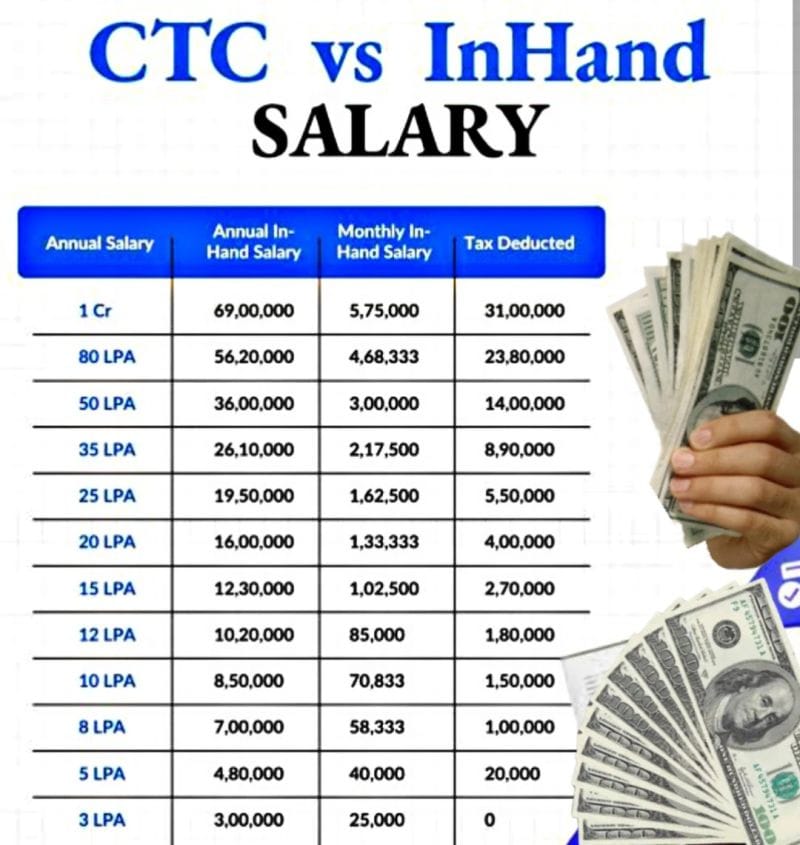
Why Understanding CTC vs In-Hand Salary is Important
For both employees and HR professionals, understanding CTC vs In-Hand Salary is essential.
For Employees
-
Helps evaluate job offers
-
Avoids confusion during salary negotiations
-
Understands real take-home pay
For HR Professionals
-
Improves transparency in salary communication
-
Helps design better compensation packages
-
Ensures payroll accuracy
Tips for Evaluating Salary Offers
Before accepting a job offer, employees should carefully analyze the CTC vs In-Hand Salary structure.
Important Tips
-
Check the basic salary percentage.
-
Understand employer PF contribution.
-
Verify deductions like taxes and professional tax.
-
Review bonus conditions.
-
Calculate the actual monthly take-home salary.
These steps help job seekers make better decisions regarding their salary package.
Conclusion
Understanding the CTC vs In-Hand Salary difference is crucial for employees, job seekers, and HR professionals. While CTC represents the total compensation offered by the company, the In-Hand Salary is the amount an employee actually receives after deductions.
Many salary components such as PF contributions, insurance, and taxes reduce the final take-home pay. Therefore, employees should carefully review their salary structure before accepting a job offer.
For HR professionals, clearly explaining CTC vs In-Hand Salary helps maintain transparency, improves employee trust, and ensures smooth payroll management.
By understanding the components, calculations, and examples discussed in this guide, anyone can easily analyze and evaluate salary packages in 2026 and beyond.
FAQs
1. What is the difference between CTC vs In-Hand Salary?
CTC is the total cost spent by the company on an employee, while In-Hand Salary is the actual amount received by the employee after deductions.
2. Is CTC the same as take-home salary?
No. CTC includes benefits, allowances, and employer contributions, while take-home salary is the net salary received monthly.
3. How can I calculate my In-Hand Salary from CTC?
You can calculate it by subtracting deductions such as PF, professional tax, and income tax from the gross salary.
4. Why is In-Hand Salary lower than CTC?
In-Hand Salary is lower because deductions like PF contributions, insurance, and taxes are included in the CTC but not paid directly to the employee.
5. What percentage of CTC is usually the In-Hand Salary?
Generally, employees receive around 65% to 80% of the CTC as their In-Hand Salary depending on deductions and salary structure.