In Human Resource Management (HRM), In Human Resource Management (HRM), understanding roles and responsibilities is essential. One way to achieve this is through Job Analysis, a systematic approach to studying jobs. It provides insights into what tasks are performed, the skills required, and the responsibilities that come with the position. Without proper evaluation, recruitment, training, performance reviews, and compensation may not align with organizational goals.
In simple terms, this process helps organizations identify the duties, responsibilities, skills, and environment associated with a particular position.
This guide will cover everything you need to know about Job Analysis, including its meaning, importance, objectives, process, methods, and real-world applications.
Job analysis provides valuable information for forecasting future staffing needs and other personnel management functions. For example, the data produced by the job analysis can be used to develop appropriate recruitment and selection methods to determine dimensions on which personnel should be evaluated, to determine the worth of jobs for compensation purposes, and to develop training programs for personnel.
A major part of the job analysis includes research, which may mean reviewing job responsibilities of current employees, researching job descriptions for similar jobs with competitors, and analyzing any new responsibilities that need to be accomplished by the person with the position. According to research by Hackman and Oldham, a job diagnostic survey should be used to diagnose job characteristics prior to any redesign of a job.
What is Job Analysis?
Job Analysis is the process of identifying and determining the details of a specific job. It focuses on:
- What tasks are performed?
- What skills, knowledge, and abilities are required?
- What responsibilities does the role carry?
- What is the job’s relationship with other positions?
- What are the working conditions?
Human resource planners can perform two types of job analyses: a task-based analysis and a competency- or skills-based analysis. A task-based analysis focuses on the duties of the job, as opposed to a competency-based analysis, which focuses on the specific knowledge and abilities an employee must have to perform the job. An example of a task-based analysis might include information on the following:
- Write performance evaluations for
- Prepare
- Answer incoming phone
- Assist customers with product
- Cold-call three customers a
Definition of Job Analysis
“Job Analysis is the process of studying and collecting information relating to the operations and responsibilities of a specific job.”
-
- “It is the systematic study of a role to identify its duties, responsibilities, skill requirements, and work conditions.
Read more: job analysis
Purpose of Job Analysis
For optimum organisational performance, it is essential to have suitable persons operating a job, which makes it necessary to understand the job in all its aspects to develop work standards and prescriptions. All physical, mental and behavioural requirements need to be stipulated to achieve desired excellence at the job. Job analysis helps promote individual excellence along with organisational, in that targets for accomplishments are known by employees in advance and performance can be measured up in accordance. Job analysis is a process, which details the criteria for successful job performance, not just the basic minimum required. The worker knows what is expected in terms of quantity and quality and makes adjustments needed.
Importance of Job Analysis
Job Analysis plays a critical role in HRM because it serves as the foundation for multiple HR activities:
- Recruitment and Selection: Helps in preparing accurate job descriptions and role specifications.
- Training and Development: Identifies skills and knowledge gaps.
- Performance Appraisal: Sets clear performance standards.
- Compensation Management: Ensures fair and equitable pay structures.
- Workforce Planning: Assists in forecasting manpower needs.
- Legal Compliance: Reduces risk of bias and ensures fairness.
Why Organizations Need It
Without properly analyzing jobs, organizations may face:
- Wrong hiring decisions
- Employee dissatisfaction
- High turnover rates
- Poor job performance
Thus, this process is not just an HR activity but a strategic necessity.
Objectives of job analysis
The major objectives include:
- Defining and clarifying job roles
- Identifying required skills and competencies
- Improving organizational efficiency
- Establishing performance standards
- Designing fair compensation structures
- Ensuring compliance with laws
- Supporting career development
Components
This activity produces two important outcomes:
1. Job Description
A Job Description is a written statement that outlines tasks, duties, responsibilities, reporting relationships, and working conditions.
Example:
- Job Title: HR Executive
- Duties: Recruitment, onboarding, payroll management
- Reporting To: HR Manager
- Working Conditions: Office-based, 9 AM to 6 PM
2. Job Specification
A Job Specification lists the qualifications, skills, knowledge, and personal attributes required.
Example:
- Education: MBA in HR
- Skills: Communication, negotiation, problem-solving
- Experience: 2–3 years in HR roles
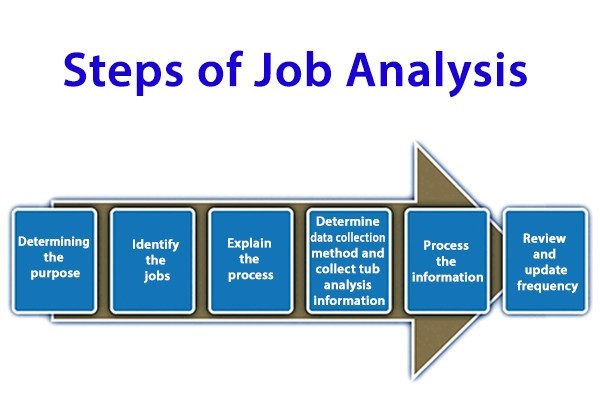
Process of Job Analysis
The steps usually involve:
- Determine the Purpose – Define why the study is being conducted.
- Select Jobs for Analysis – Prioritize critical roles.
- Collect Job Information – Use interviews, questionnaires, or observation.
- Analyze the Information – Break down tasks, duties, responsibilities, and skills.
- Prepare Job Description and Specification – Document findings.
- Review and Update – Adjust periodically as jobs evolve.
7 Key Steps of Job Analysis
-
Identify the Purpose
-
Decide why the Job Analysis is being conducted (e.g., recruitment, training, job redesign).
-
-
Select the Job to be Analyzed
-
Choose which job(s) need analysis. Usually, critical or frequently changing roles are prioritized.
-
-
Collect Job Information
-
Use methods like interviews, questionnaires, observation, or employee work diaries to gather data.
-
-
Examine the Information
-
Analyze tasks, responsibilities, skills, and working conditions. Break down the job into smaller elements.
-
-
Prepare a Job Description
-
Write a detailed document describing the duties, responsibilities, reporting structure, and work environment.
-
-
Develop a Job Specification
-
Define the qualifications, skills, knowledge, experience, and personal traits needed to perform the job.
-
-
Review and Update Regularly
-
Jobs evolve with technology and organizational needs, so Job Analysis should be reviewed periodically.
-
Methods
There are several techniques to conduct an analysis:
1. Observation
- HR professionals observe employees while they perform tasks.
- Best for manual or routine jobs.
2. Interview
- Employees and supervisors are interviewed for details.
- Provides in-depth insights.
3. Questionnaire
- Structured forms are filled by employees.
- Example: Position Analysis Questionnaire (PAQ).
4. Critical Incident Method
- Identifies behaviors that lead to success or failure.
5. Functional Job Analysis
- Breaks jobs into data, people, and things for classification.
6. Work Diary/Log
- Employees record daily activities for a certain period.
Benefits
- Improves recruitment quality
- Enhances employee performance
- Reduces turnover
- Supports training programs
- Promotes fair compensation
- Ensures compliance with regulations
- Boosts productivity
Challenges
Some common challenges are:
- Time-consuming process
- Employee resistance
- Difficulty in analyzing complex jobs
- Rapid changes in technology
- High costs
Applications in HRM
1. Recruitment and Selection
Accurate descriptions ensure the right candidates are hired.
2. Training and Development
Identifies skill gaps.
3. Performance Appraisal
Provides objective standards for measurement.
4. Compensation Management
Ensures fair pay.
5. Job Design and Redesign
Helps in creating efficient jobs.
6. Legal and Compliance
Protects against discrimination claims.
Real-Life Examples
- IT Industry: Defines roles like software developer or project manager.
- Healthcare Industry: Clarifies responsibilities of doctors and nurses.
- Manufacturing Industry: Develops standard operating procedures (SOPs).
Future Outlook
With the rise of AI and remote work, job evaluation is evolving. HR analytics and AI-based systems make the process more dynamic. Organizations are shifting to competency-based analysis, focusing on behavioral and technical skills.
Conclusion
This systematic process is the backbone of HRM. From recruitment to training, performance appraisal to compensation, every HR activity relies on accurate job evaluation. Organizations that invest in analyzing roles reduce turnover, improve job satisfaction, and create a more productive workforce.
By implementing this approach strategically, HR managers can support both organizational success and employee growth.
FAQs
Q1. What is the difference between Job Analysis and Job Evaluation?
- Analysis studies the content of a job, while evaluation determines its worth.
Q2. Who conducts the analysis?
- Usually HR professionals with input from supervisors and employees.
Q3. How often should it be done?
- Ideally every 2–3 years or after major changes.
Q4. Is it useful for small businesses?
- Yes, it helps structure roles and responsibilities.
Q5. Does it apply to remote jobs?
- Absolutely, especially for clarifying expectations in hybrid settings.