New Labour Law 2025 India: Major Changes Every Employee Must Know
India’s employment system has undergone one of its biggest reforms in decades with the implementation of the New Labour Law 2025 India. Earlier, around 29 different labour laws governed wages, industrial disputes, safety standards, gratuity, and social security—often creating confusion, overlapping compliance, and unequal coverage across sectors.
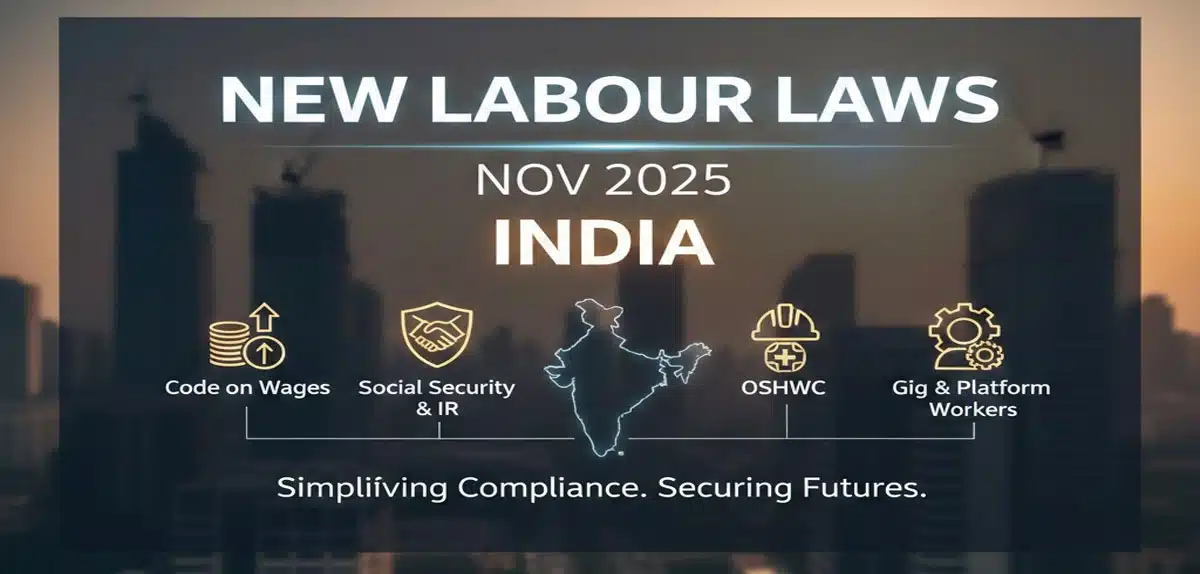
With effect from 21 March 2025, these laws have been consolidated into four simplified Labour Codes covering wages, industrial relations, social security, and occupational safety. The objective is to create a uniform national framework that protects workers’ rights while making compliance easier for businesses.
The New Labour Law 2025 India introduces significant changes in minimum wages, salary payment timelines, gratuity eligibility, gig worker recognition, working hours, appointment letters, women’s employment rights, and industrial dispute resolution. Importantly, it expands social security coverage to millions of workers in the unorganized, platform, and fixed-term employment sectors who were previously outside formal protection.
Whether you are an employee, employer, gig worker, HR professional, or business owner, understanding these reforms is essential. These new rules directly impact salary structure, overtime pay, leave policy, job contracts, workplace safety, and dispute resolution mechanisms across India.

What is this new Labour Law?
-
Earlier, there were about 29 different labour laws 2025 India in the country – with different rules and compliance requirements.
-
Now they have been merged into 4 Labour Codes:
-
Code on Wages, 2019
-
Industrial Relations Code, 2020
-
Code on Social Security, 2020
-
Occupational Safety, Health & Working Conditions (OSHWC) Code, 2020
-
-
These four codes have been implemented from 21 March 2025, and under them your salary, leave, overtime, gratuity, safety, etc. will all be covered.
Who are these new laws for?
-
After the codes come into force, about 40 crore workers will come under the social security net for the first time — meaning more than half of the workforce will be covered.
-
Earlier labour laws mainly focused on the organized sector; now the coverage has been expanded.
-
Gig workers (such as those working with Zomato, Swiggy, Ola, Uber)
-
Platform workers
-
Contract and fixed-term employees
-
Migrant workers and workers in sectors like construction, mining, IT/ITES, ports, transport, etc.
-
This means the laws will now cover not only full-time permanent employees but also new types of jobs.
When is an appointment letter mandatory?
The appointment letter should clearly state all these things.
- Your post, nature of work, salary, working hours, leave policy and other benefits etc.
- The benefit of this is that later on, there will be less disputes like I did not say this or this was not in your profile. If the case goes to court, then the appointment letter will be your biggest proof of return.
- If you do not have a written appointment letter yet, then under the new law you can get it, this is your right.
Minimum Wages and Salary on Time (for everyone – national security law)
Under the new codes, the government’s concept is that a national framework should be created across the country, so that salary does not go below a minimum and basic livelihood is ensured.
Important Points:
• Minimum Wage will apply to all workers – earlier many categories were kept outside it.
• Salary payment on time is mandatory – in many sectors salary must be paid before the 7th of the month.
Practical Impact:
• Especially in the unorganized sector where salary was often delayed, workers will now have legal remedy.
• It will also control unfair practices.
What should employees do right now?
-
Take a written appointment letter from your company – if you haven’t received it, politely demand it; it’s your right.
-
Keep both soft and hard copies of your salary slips, appointment letter, and contract agreements safely.
-
If you are a gig or platform worker, keep an eye on upcoming social security schemes – whenever registration opens on any portal, update your data there.
-
If you are doing overtime:
-
Make sure your overtime hours are recorded in writing somewhere – company system, email, register – so that there is no problem in claiming double overtime pay.
-
-
For any serious issue (salary not paid, unfair termination, harassment, safety violations), contact HR, the Labour Department, or take legal help as soon as possible – delaying can weaken both your proof and your remedy.
Conclusion
The New Labour Law 2025 India represents a major structural reform of the country’s employment framework. By merging 29 old labour laws into four comprehensive codes, the government aims to simplify compliance, expand social security coverage, and create uniform standards for wages, working conditions, and dispute resolution.
For employees, the law brings stronger protections such as mandatory appointment letters, minimum wage coverage for all workers, timely salary payments, gratuity benefits for fixed-term employees, overtime safeguards, and formal recognition of gig and platform workers.
For employers, it offers streamlined compliance through single registration, simplified returns, and clearer regulations. However, its real success will depend on effective implementation, enforcement, and awareness among workers about their rights.
Understanding the New Labour Law 2025 India is crucial for both employees and businesses to ensure lawful practices, financial security, and smoother industrial relations in the years ahead.
Frequently Asked Questions (FAQs)
1. What is the New Labour Law 2025 India?
The New Labour Law 2025 India refers to the implementation of four consolidated Labour Codes that replace 29 old labour laws and regulate wages, industrial relations, social security, and workplace safety.
2. When did the new labour law 2025 India come into effect?
The four Labour Codes have been implemented from 21 March 2025.
3. Is an appointment letter mandatory under the new law?
Yes. Employers are now required to provide a written appointment letter to every employee clearly mentioning job role, salary, working hours, leave policy, and benefits.
4. What is the new rule for gratuity?
In certain cases, especially for fixed-term employees, gratuity can now be claimed after completing 1 year of service instead of the earlier 5-year requirement.
5. Are gig workers covered under the new labour law 2025 India?
Yes. Gig workers and platform workers (such as delivery partners and ride-sharing drivers) are now legally recognized and are eligible for social security benefits funded partly by aggregators.
6. What is the maximum working hour limit?
The weekly working hour limit remains 48 hours. However, companies may structure shifts differently (such as 12-hour shifts) as long as the total weekly hours do not exceed 48.
7. When must salary be paid?
Salary must be paid on time, generally before the 7th of the following month in most sectors.
8. Does the new law apply to unorganized sector workers?
Yes. The scope has been expanded to cover a large number of workers from the unorganized sector, including migrant workers and digital platform workers.