Performance appraisal methods play a vital role in managing employee performance in modern organizations. In today’s competitive business environment, companies need structured systems to evaluate, improve, and reward employee performance effectively.
Performance appraisal methods help HR professionals measure productivity, identify skill gaps, and align employee goals with organizational objectives. Without a proper appraisal system, organizations may struggle with low morale, high turnover, and poor performance.
This comprehensive guide explains the 8 modern performance appraisal methods every HR professional should know in 2026, including benefits, examples, and practical applications.

What Are Performance Appraisal Methods?
Performance appraisal methods are systematic techniques used by organizations to evaluate employee performance over a specific period. These methods help measure work quality, productivity, behavioral competencies, and goal achievement.
Performance appraisal methods are used to:
-
Assess employee contribution
-
Identify strengths and weaknesses
-
Plan promotions and salary increments
-
Improve training and development
-
Enhance employee engagement
In HRM, selecting the right performance appraisal methods ensures fairness and transparency in evaluation.
Importance of Performance Appraisal Methods
Performance appraisal methods play a crucial role in modern human resource management. They help organizations evaluate employee performance systematically and ensure alignment between individual efforts and organizational goals. A well-designed appraisal system not only measures productivity but also supports employee growth and organizational success.
Below are the key reasons why performance appraisal methods are important in every organization.
1. Provides Constructive Feedback
One of the primary importance of performance appraisal methods is that they provide structured and constructive feedback to employees. Feedback helps employees understand:
-
Their strengths
-
Areas needing improvement
-
Performance gaps
-
Behavioral expectations
Regular feedback improves communication between managers and employees. It allows employees to correct mistakes, enhance skills, and perform better in the future.
Without proper appraisal systems, employees may not know whether they are meeting expectations or falling short.
2. Recognizes and Rewards Employee Achievements
Performance appraisal methods help organizations identify and recognize high-performing employees. Recognition is essential for maintaining morale and encouraging continued excellence.
When employees feel their hard work is acknowledged:
-
Job satisfaction increases
-
Loyalty improves
-
Employee engagement becomes stronger
Recognition can come in many forms, such as promotions, bonuses, appreciation awards, or public acknowledgment. Celebrating achievements and creates a positive training methods of workplace culture.
3. Supports Clear Goal Setting
Another major importance of performance appraisal methods is goal setting. During appraisal discussions, managers and employees can set clear, measurable, and realistic objectives for the future.
Effective goal setting:
-
Aligns employee objectives with company goals
-
Clarifies expectations
-
Increases accountability
-
Improves focus and productivity
Methods such as Management by Objectives (MBO) are especially useful for linking performance with measurable targets.
4. Identifies Training and Development Needs
Performance appraisal methods help detect skill gaps and areas where employees need improvement. By analyzing appraisal results, HR professionals can design targeted training and development programs.
For example:
-
Communication skill workshops
-
Leadership training
-
Technical skill development
-
Time management training
This ensures continuous learning and professional growth. Development-focused appraisal systems prepare employees for higher responsibilities and future leadership roles.
5. Enhances Employee Motivation
Motivation is directly connected to recognition and growth opportunities. When employees know their efforts are evaluated fairly and rewarded appropriately, they are more motivated to perform better.
Performance appraisal methods:
-
Encourage healthy competition
-
Promote accountability
-
Provide opportunities for advancement
-
Create a sense of achievement
A transparent appraisal system builds trust and encourages employees to take ownership of their performance.
6. Supports Strategic Decision-Making
Appraisal results provide valuable data for important HR decisions. Organizations use performance evaluation outcomes to make decisions such as:
-
Promotions
-
Salary increments
-
Bonuses and incentives
-
Transfers
-
Termination decisions
Having structured performance appraisal methods ensures that these decisions are based on objective data rather than personal bias.
Data-driven decisions reduce conflicts and improve fairness within the organization.
Objectives of Performance Appraisal
Before discussing modern performance appraisal methods, it is important to understand their objectives.
-
Measure employee performance
-
Identify training needs
-
Improve productivity
-
Support compensation decisions
-
Enhance communication between managers and employees
-
Motivate employees
When performance appraisal methods are properly implemented, they contribute significantly to organizational growth.
8 Modern Performance Appraisal Methods
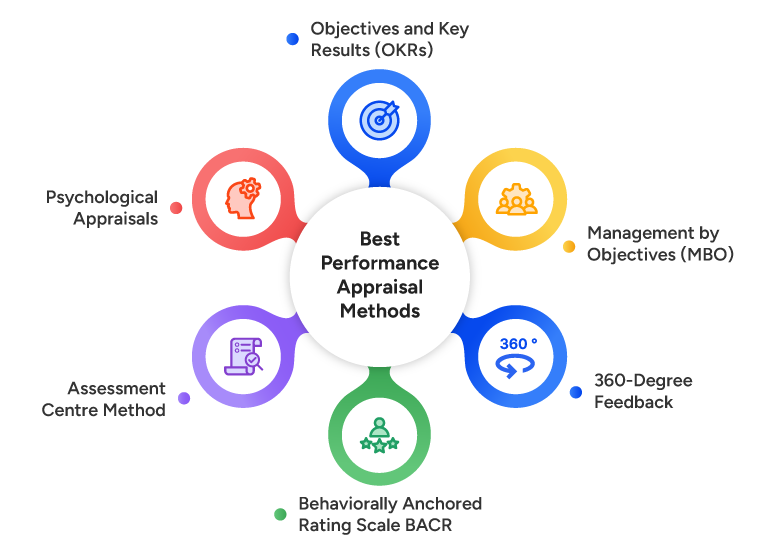
Modern organizations no longer rely only on traditional annual reviews. Today’s HR practices emphasize continuous feedback, measurable goals, behavioral evaluation, and multi-source input. Modern performance appraisal methods focus on fairness, transparency, employee development, and alignment with business objectives.
Let us explore the 8 most important performance appraisal methods used in modern HR practices in detail.
1. 360-Degree Performance Appraisal
The 360-degree appraisal method is one of the most comprehensive and widely used modern performance appraisal methods. Unlike traditional evaluations where only a supervisor assesses an employee, this method collects feedback from multiple sources.
Who provides feedback?
-
Immediate supervisor
-
Peers or colleagues
-
Subordinates
-
Self-assessment
-
Customers or clients (if applicable)
This method provides a complete view of employee performance, behavior, leadership qualities, communication skills, and teamwork abilities.
Why it is effective:
-
Reduces individual bias
-
Encourages accountability
-
Improves leadership development
-
Promotes open communication
Example:
A project manager is evaluated not only by their reporting manager but also by team members and clients. This gives a holistic understanding of their performance.
This method is especially useful for managerial and leadership roles.
2. Management by Objectives (MBO)
Management by Objectives (MBO) is a goal-based performance appraisal method where employees and managers work together to set specific, measurable, and achievable objectives.
Instead of focusing only on behavior, MBO emphasizes results and outcomes.
Process:
-
Set clear objectives
-
Define performance standards
-
Monitor progress
-
Evaluate results
Advantages:
-
Clear performance expectations
-
Measurable outcomes
-
Strong alignment with company goals
-
High employee involvement
For example, a sales executive may have a target to achieve ₹20 lakh sales in a quarter. Their performance is evaluated based on achieving this goal.
MBO works well in performance-driven industries such as sales, marketing, and production.
3. Behaviorally Anchored Rating Scale (BARS)
The Behaviorally Anchored Rating Scale (BARS) is a structured and objective performance appraisal method that combines rating scales with specific behavioral examples.
Instead of vague ratings like “good” or “poor,” BARS provides detailed behavior descriptions at each performance level.
Example (Customer Service Role):
-
5 – Handles customer complaints calmly and resolves issues independently.
-
3 – Resolves complaints with supervision.
-
1 – Frequently escalates complaints without attempting solutions.
Benefits:
-
Reduces subjectivity
-
Clearly defines expectations
-
Improves consistency in evaluation
BARS is ideal for roles where behavior significantly impacts performance, such as customer service, healthcare, and hospitality.
4. Critical Incident Method
The Critical Incident Method focuses on specific events where an employee demonstrated exceptional or poor performance to help organization to create job analysis.
Managers maintain a record of important incidents throughout the evaluation period.
Examples:
-
Successfully handled a major client crisis
-
Failed to meet an important project deadline
-
Demonstrated exceptional leadership during a team conflict
Advantages:
-
Real performance-based feedback
-
Detailed evaluation
-
Encourages consistent observation
However, this method requires proper documentation throughout the year. It cannot rely on memory alone.
This method is highly useful in dynamic roles where critical decisions matter.
5. Rating Scale Method
The Rating Scale Method is one of the most common and simple performance appraisal methods used in organizations.
Employees are rated on various parameters such as:
-
Communication skills
-
Teamwork
-
Leadership
-
Punctuality
-
Productivity
-
Problem-solving ability
Each factor is rated on a numerical scale, usually from 1 to 5.
Advantages:
-
Easy to use
-
Simple to understand
-
Suitable for large organizations
Limitations:
-
May involve evaluator bias
-
Can lack detailed feedback
Although considered traditional, many companies still use improved versions of the rating scale method combined with modern tools.
6. Assessment Center Method
The Assessment Center Method is a highly reliable and scientific performance appraisal technique used primarily for evaluating managerial and leadership positions.
In this method, employees participate in:
-
Group discussions
-
Role plays
-
Case studies
-
Presentations
-
Simulation exercises
Trained assessors observe and evaluate performance across different competencies.
Advantages:
-
Accurate leadership evaluation
-
Real-world skill assessment
-
Objective performance measurement
This method is expensive and time-consuming but very effective for promotions and succession planning.
7. Psychological Appraisal Method
The Psychological Appraisal Method focuses on assessing an employee’s emotional, cognitive, and personality traits rather than just job performance.
This method evaluates:
-
Emotional intelligence
-
Motivation level
-
Interpersonal skills
-
Leadership potential
-
Stress tolerance
It is usually conducted by trained psychologists or HR specialists.
When it is used:
-
Leadership development programs
-
Senior management roles
-
Succession planning
Psychological appraisal helps organizations understand the long-term potential of employees.
8. Self-Assessment Method
The Self-Assessment Method allows employees to evaluate their own performance based on predefined criteria.
Employees reflect on:
-
Achievements
-
Challenges faced
-
Skills improved
-
Areas needing development
Benefits:
-
Encourages self-awareness
-
Promotes ownership of performance
-
Enhances open discussions during appraisal meetings
However, self-assessment should not be the only evaluation method. It works best when combined with supervisor feedback or 360-degree appraisal.
Traditional vs Modern Performance Appraisal Methods
| Traditional Methods | Modern Methods |
|---|---|
| Simple rating scale | 360-degree feedback |
| Supervisor-only evaluation | Multi-source evaluation |
| Annual review | Continuous feedback |
| Limited employee involvement | High employee participation |
Modern performance appraisal methods focus on transparency and continuous improvement.
Benefits of Using Modern Performance Appraisal Methods
-
Increased employee engagement
-
Better communication
-
Reduced bias
-
Clear career growth path
-
Data-driven HR decisions
-
Improved productivity
Organizations that use structured performance appraisal methods see higher employee satisfaction.
Common Challenges in Performance Appraisal
Even modern performance appraisal methods face some challenges:
-
Bias in evaluation
-
Lack of proper training
-
Resistance from employees
-
Poor documentation
-
Unrealistic performance targets
HR managers must design fair systems to overcome these issues.
Best Practices for Effective Performance Appraisal
To make performance appraisal methods effective:
-
Set clear goals
-
Provide continuous feedback
-
Train managers
-
Use multiple evaluation sources
-
Ensure transparency
-
Align appraisal with rewards
Regular review of the appraisal system is also essential.
How to Choose the Right Performance Appraisal Method
The right method depends on:
-
Organization size
-
Industry type
-
Job role complexity
-
Company culture
For example:
-
Startups may prefer MBO
-
Large corporations may use 360-degree feedback
-
Sales teams may benefit from KPI-based evaluation
Future of Performance Appraisal Methods (2026 Trends)
Modern organizations are shifting toward:
-
Continuous performance management
-
AI-based evaluation tools
-
Real-time feedback systems
-
Data analytics in HR
Technology is transforming performance appraisal methods in HRM.
Conclusion
Performance appraisal methods are essential for measuring, improving, and rewarding employee performance. Modern organizations rely on structured and data-driven appraisal systems to enhance productivity and engagement.
The 8 modern performance appraisal methods discussed in this guide help HR professionals choose the right evaluation technique based on organizational needs.
By implementing the right performance appraisal methods, companies can create a motivated, high-performing workforce aligned with business goals.
Frequently Asked Questions (FAQs)
1. What are performance appraisal methods?
Performance appraisal methods are systematic techniques used by organizations to evaluate employee performance and productivity.
2. Which is the best performance appraisal method?
The 360-degree feedback method is considered one of the most effective modern performance appraisal methods because it collects feedback from multiple sources.
3. What is the difference between performance appraisal and performance management?
Performance appraisal is a periodic evaluation process, while performance management is a continuous system of monitoring and improving performance.
4. How often should performance appraisal be conducted?
Most organizations conduct performance appraisal annually, but modern companies prefer quarterly or continuous reviews.
5. Why are modern performance appraisal methods important?
Modern performance appraisal methods reduce bias, improve transparency, and align employee performance with organizational goals.