Training and development are one of the most important parts of human resource management. Both these activities are practised by the organisations to improve the performance of the employees and enhance their skills, knowledge, and efficiency.
When we talk about training alone, it is a process or an activity that firms carry to impart knowledge and know-how skills to their employees that are necessary for their job functions. For example, a computer operator is trained to work on new software that will help him to perform better on his job.
Thus, training helps the employees to comprehend their job requirements and achieve them in a better way. It is a planned, organised, and structured activity that brings about a semi-permanent change in behaviour and emphasises the current job of the employee.
“Training is a process by which the aptitudes, skills, and abilities of employees perform specific jobs are increasing”.
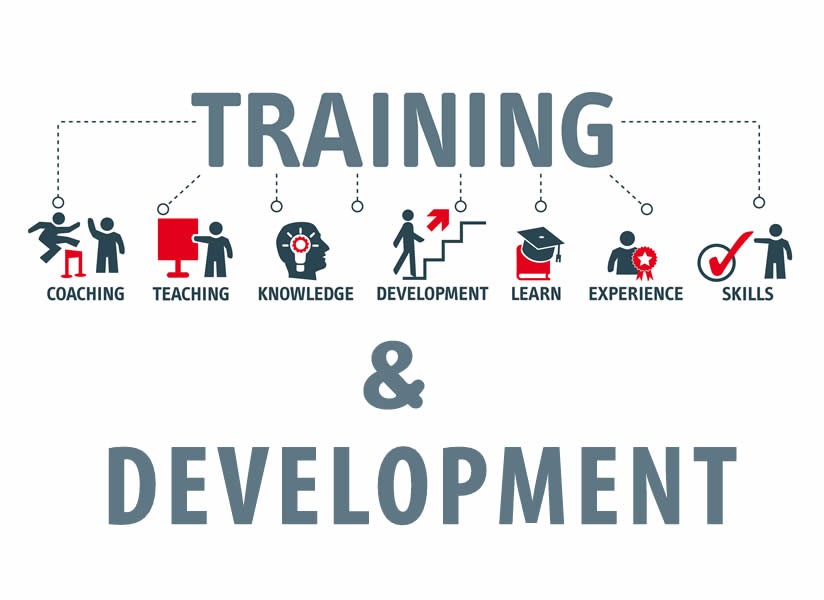
Role of Training:
● To increase efficiency and productivity.
● To boost up employee morale.
● To minimise supervision.
● To minimise wastage of resources.
● To cope with organisational complexity.
● To increase stability and organisational flexibility.
● To prepare a backup for future manpower requirements.
● To provide opportunities for promotions and self-development.
● To reduce accidents.
● To reduce learning time.
● To facilitate better management.
Coming to the concept of development, it is primarily taken for the top-level managers where the focus is more on bringing about a change in the personality and overall development of individuals to face and deal with forthcoming challenges with confidence.
It can be described as an activity that primarily emphasises those activities that an organisation may undertake in nearby future and is difficult to evaluate.
The development process is a long-term educational process and has a broader vision. The development process is a systematic process of training. The managers and executives acquire skills along with competencies in their jobs and also gain capacities for future tasks.
“Development is a series of organised activities, conducted within a specialised time and designed to produce behavioural changes”.
Role of Development:
● To create a learning culture in the organisation.
● To help employees to do their best.
● Helps employees to self-analyse themselves.
● Enhancement of not only job-related skills but also upgrade the existing knowledge and gain competencies for future.
● To strengthen the employee relationships.
Factors Influencing Training and Development:
● The training and development programmes can be successful only if these are supported by the top management. The top executives must actively initiate these programmes as training and development activities need resources and funds.
● With developments in the area of technology, training and development programmes have changed their outlook tremendously. Today, almost all firms are widely using means of technology to conduct training and development sessions more effectively as compared to the conventional means.
The trainers are merely the specialists and experts in concerned areas. The chief responsibilities lie with managers and executives at all levels as to how these training and development programmes need to be conducted when to be conducted, and for whom.
● Training and development is the need of the hour. Employees are willingly upgrading their skills. The organisation structures are also changing rapidly due to changes in technology, changes in consumer demands, innovations, and so on. The supervisor levels are taking up more work at a complex level. Thus, imparting training and developing the personnel has become a necessity.
● The learning behaviour of the employees influences training and development to a great extent. The activities will be fruitful only when learners are willing to learn. As said, ‘the best to learn is when the learning can be useful’.
● The human resource functions like recruitment and selection also affect training and development requirements. For instance, if organisations recruit and select employees at low compensation levels, the need for training and development will be more as marginally skilled workers are most likely to join the firms. Conversely, if highly skilled workers are appointed, the need for training and development activities will be less, but demand for remuneration packages will be more.
Advantages of Training and Development:
● Helps employees to develop new skills and along with enriching the existing skills.
● Improves individual and team efficiencies.
● Create new job positions and improve the existing ones
● Creates a cordial organisational environment.
● Increases employee motivation levels and encourage their participation and contribution levels.
● Reduced employee turnovers and absenteeism.
Disadvantages of Training and Development:
● The training and development activities incur a good amount of expenses.
● The activities are time-consuming.
● There is always a risk involved that the employees might leave the current job for better prospects after getting trained and upgrading one’s skills.
Reasons or Needs for Training and Development:
● When management figures out that the performance of the employees needs to be worked upon.
● Any specific job responsibility requires training.
● Need to set up a benchmark of improvement.
● Testing any new methodology to increase productivity.

Training and development hold a crucial contribution to the effectiveness of organisations as well as add positively to the experiences of people in work. Training the workforce contributes to productivity, safety, and personal development.
Organisations realise the importance of training and development activities and invest not only funds but also efforts to train and develop their staff. Even if investing in these activities involve expenses, directing time and attention of employees in activities other than main business areas, obtaining and maintaining premises and equipment, paying for trainers and also salaries to staff even if they are not attending the regular business operations for a few days, still, all these expenses and investments are considered good to maintain expertise for the present and the future.
Training and Development Process
Stage 1
Training Needs Assessment (TNA): This method identifies if there is a need for training or not. And, in case such a need exists, what type of training would fill the gaps.
Stage 2
Design of the Training and Development: The design should align with the mission and vision of the organisation.
The design of training and development is concerned with defining and identifying the objectives, scope of training, methods to be adopted, technology to be considered, and other important considerations.
Stage 3
Implementation of Training and Development: The organisation must ensure that the trainers are ready to deliver, and trainees are ready to grasp and learn.
Stage 4
Monitoring, Evaluation of Training and Development: Monitoring and evaluation help to determine the success levels of the programme.
7 Key Concepts
1. Skill Enhancement and Knowledge Development
Training and development focus on improving employees’ technical skills, job knowledge, and competencies. Training helps employees perform their current tasks efficiently, while development equips them with broader knowledge and abilities for future roles and responsibilities.
2. Performance Improvement
One of the primary concepts of training and development is enhancing employee performance. Well-planned training programmes reduce errors, improve work quality, increase productivity, and help employees meet organisational performance standards.
3. Behavioural and Attitudinal Change
Training and development aim to bring positive changes in employees’ behaviour, attitude, and work habits. Effective programmes help employees develop discipline, teamwork, adaptability, and a positive approach towards organisational goals.
4. Long-Term Employee Growth
While training is short-term and job-oriented, development is a long-term process focused on personal and professional growth. Development programmes prepare employees, especially managers, to handle future challenges, leadership roles, and organisational responsibilities.
5. Organisational Effectiveness and Productivity
Training and development contribute directly to organisational effectiveness. A skilled and motivated workforce improves operational efficiency, reduces supervision, minimises wastage, and supports organisational stability and flexibility.
6. Adaptation to Technological and Environmental Changes
Rapid changes in technology, work processes, and market demands require continuous learning. Training and development help employees adapt to new tools, systems, and organisational changes, ensuring competitiveness and innovation.
7. Employee Motivation and Retention
Training and development increase employee motivation by providing learning opportunities, career growth, and promotion prospects. Employees who feel valued and developed are more engaged, loyal, and less likely to leave the organisation.
Nature of Training and Development
● The training aims to impart specific skills so that employees can improve and perform better
● Training includes education and learning
● Development improves the overall personality of an individual
● Development is not a one-shot affair but is a continuous process
● Both training and development are the components of the same system
Conclusion
Training and Development play a vital role in the growth and success of any organisation. Training focuses on improving employees’ job-related skills and efficiency, while development aims at the long-term growth of individuals by enhancing their overall personality, capabilities, and readiness for future challenges. Together, they help organisations build a skilled, confident, and adaptable workforce.
In a rapidly changing business environment driven by technology, innovation, and increasing competition, continuous training and development have become a necessity rather than an option. These activities not only improve productivity and performance but also increase employee motivation, job satisfaction, and organisational commitment. Although training and development involve time, cost, and effort, their long-term benefits far outweigh the limitations.
Ultimately, organisations that invest in structured training and development programmes are better equipped to achieve their goals, maintain a competitive edge, and ensure sustainable growth. At the same time, employees benefit through enhanced skills, career advancement opportunities, and personal development, making training and development a win-win strategy for both employers and employees.
Frequently Asked Questions (FAQs)
1. What is Training and Development in Human Resource Management?
Training and Development in Human Resource Management refers to planned activities designed to improve employees’ skills, knowledge, behaviour, and overall personality. Training focuses on current job performance, while development prepares employees for future roles and responsibilities.
2. What is the difference between training and development?
Training is a short-term and job-oriented process aimed at improving specific skills required for present tasks. Development, on the other hand, is a long-term process that focuses on the overall growth, personality development, and future potential of employees, especially managers and executives.
3. Why is training and development important for organisations?
Training and development are important because they enhance employee productivity, improve work quality, reduce errors and accidents, boost morale, and help organisations adapt to technological and environmental changes. They also support succession planning and organisational stability.
4. Who needs training and development in an organisation?
Training is required at all levels of the organisation, including workers, supervisors, and middle-level managers. Development programmes are generally designed for top-level managers and executives to prepare them for strategic decision-making and leadership roles.
5. What are the main stages of the training and development process?
The main stages of the training and development process include Training Needs Assessment, designing the training programme, implementation of training, and monitoring and evaluation to measure effectiveness and outcomes.