Training in Human Resource Management plays a crucial role in improving employee performance, productivity, and organizational efficiency. In today’s competitive business environment, organizations must continuously upgrade employee skills to keep pace with technological changes, market demands, and evolving job roles. Training helps employees acquire the knowledge, skills, and abilities required to perform their jobs effectively and efficiently.
Training is not just about teaching employees how to do their current work; it is a systematic process that enhances competence, reduces errors, boosts confidence, and prepares employees to meet organizational goals. Effective training programs help organizations build a skilled workforce, improve job satisfaction, and maintain a competitive advantage in the market.
This complete guide on Training in Human Resource Management explains the meaning, objectives, importance, types, methods, and training process in a simple and easy-to-understand manner. It is especially useful for HR students, MBA learners, and professionals who want a strong foundation in employee training concepts.
Meaning and Definition of Training
Training is the organized procedure by which employees learn knowledge and skills and abilities required to perform their current job effectively.
Training in human resource management can be described as a process of improving skills and gaining knowledge through a structured and planned mechanism. It is not a one-time effort, but a regular process of clarifying concepts. It creates an impact that lasts beyond the end time of the training itself.
The training process in human resource management consists of six steps:
- Step 1: Assessing the objectives and strategies of the organisation. This helps the firms to assess the strengths and weaknesses of their employees and provide training activities accordingly.
- Step 2: Assessing training needs. The training programmes need funds and resources. Therefore, assessment of needs should be in the right direction so that the organisation can plan the right trainees, the right type of training method, the time to be taken, who should train, and so on.
- Step 3: Establishing training and development goals. In the absence of clear and specific goals, the right training programme cannot be designed. The goals should be measurable and verifiable.
- Step 4: Designing the programme. The design should be able to answer questions such as who will be the trainees and the trainers, where and how should the training be conducted, techniques to be used, etc.
- Step 5: Implementing the programme.
- Step 6: Evaluating results. The success or even the failure of the programme should be evaluated.
Types of Training in Human Resource Management
1. Technical training:
Any training in human resource management given to employees to teach about any technological aspect or a technology change is technical training. As believed that there is always room for improvement, technical training helps employees to cope with a new technology or get more comfortable with an existing one.
For instance, an accountant can get training on the usage of new accounting software, or a digital marketer can get training as to how to create online content. Such training helps employees to perform their jobs more efficiently, and also boosts up their confidence and opens lucrative avenues.
2. Quality training:
This type of training in human resource management allows employees to maintain as well as uplift the quality standards at the workplace. The focus is to help the employees eliminate wastage, detect non-quality items, and prevent a lack of quality.
This training is quite essential in production units since quality standards need to be maintained to keep a competitive edge along with eliminating wastages and cost minimisation. Training given for ISO protocols is a type of quality training.
3. Skills training:
As evident from the term, this training is in human resource management imparted to improve and enrich the current skill set of employees. The skills could be technical skills or non-technical skills. For instance, training is given to customer care executives to handle customer enquiries is skill training.
4. Soft Skills training:
Soft skills relate to the personality traits, attitudes, and behavioural aspects of employees. Employees need to be motivated so they can perform better. In addition, training is given to employees about effective communication skills, interpersonal relationships, personality traits, leadership qualities, team management skills etc.
Such pieces of training help employees to identify themselves concerning their strengths, weaknesses, personality traits etc and help to develop themselves for good. Employees are also trained in public speaking and adaptability skills. The soft skills training ensures success not only professionally, but also in personal aspects.
5. Professional training and Legal training:
These pieces of training in human resource management are concerned with complying with professional needs and legal aspects. For instance, very often laws related to taxation policies, employment regulation, industrial policies etc get changed. Thus, the concerned person must be trained regularly to keep pace with the industrial environment.
6. Leadership training:
An effective leader is capable of influencing, motivating, and enabling others to perform to their best potential. Leadership training is essential for organisations to identify employees with strong leadership qualities, and further guide them to enrich their leadership skills so that they can derive the best out of their teams.
The leadership training helps leaders to identify themselves along with improving leadership styles. This will further lead to an increase in the productivity of the team members and create cordial and united teamwork.
Training methods in human resource Management
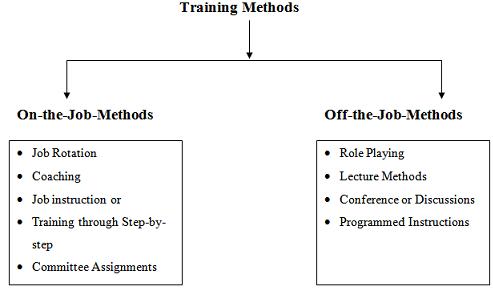
On-the-job training
Job Rotation: The shifting of employees between various positions at regular intervals of time is job rotation. This helps to analyse the right person at the right place. The employee gets trained on how to perform different tasks over time.
This helps firms to fill up the gaps in case of any vacancy. Moreover, the employee also gets a break from the regular nature of his/her work. The employee also gets trained to understand the nature of work at other positions. This helps the employee to become a multi-skilled employee.
However, it is time-consuming and costly and might not be suitable for all types of industries.
Coaching: The trainee works under a coach who acts as a guide and supervisor. It is a type of one-to-one training in human resource management where the trainee gets suggestions from the coach to improve one’s performance.
A limitation of coaching training is that the freedom of the trainee to express oneself depends a lot upon the nature of the coach.
Job Instructions: As the terminology depicts, when step-by-step instructions are given by the trainer to the trainee, it is known as job instruction training. It is a structured form of training where the trainer also demonstrates and give necessary instructions.
A mechanism for raising queries and feedback is provided alongside.
Committee or Team Assignments: The trainees work in teams and try to resolve a common issue. This facilitates team building.
Internship: This type of training is temporary. The emphasis is more on learning and hands-on training in human resource management rather than getting a job or employment. It can be either paid or unpaid.
The interns may not be the employees of the company but get exposure to the actual working environment. Usually, students take up internships to learn the necessary skills.
Apprenticeship: When training is undertaken to learn specific skills of a particular industry and is paid for, it is apprenticeship. The apprenticeship is for a longer duration in comparison to an internship and usually turns into a full-time job.
According to Noe, apprenticeship involves working and studying at the same time. The unskilled person gets trained by a skilled person, and the biggest merit of apprenticeship is the remuneration is paid.
Understudy: This training is like working as an assistant to a superior to get training and learn the aspects of the work. The training prepares the trainee to independently handle the responsibilities and tasks in future.
Off-the-Job training methods:
Classroom Lectures: The trainees and participants get trained in a classroom like-environment. Usually, white-collar employees are trained via lectures.
The sessions are taken to cover aspects related to the administrative or management aspects, providing information and instructions on a particular matter, job responsibilities, and so on.
Simulations: The training in human resource management is given with the help of equipment and machines that resemble the real-life scenario. The trainee or the learner performs the activities in a real-life scenario so that one can be trained to perform when the actual event occurs.
For example, flying a simulator model of an aeroplane and getting trained before flying a real one. Cole (2022) describes simulation as a situation where the training is given to the trainee in a controlled, but near-perfect work environment.
An advantage of simulation training is that the occurrence of accidents gets reduced.
Vestibule Training: The trainees get training outside the work premises. The training is chiefly provided to those involved with semi-skilled jobs. The equipment and materials that are used in the real working conditions are demonstrated outside the real working place. The emphasis is more on instructions and the instructors usually cater to a large group of trainees.
Case Studies: The trainees receive a written description of a real-life situation that has occurred. The concept is to analyse the case study and provide conclusions. The trainees thus can analyse pros and cons, figure out various options, and improve their decision-making skills.
Such training activities develop analytical and critical thinking skills and also improve problem-solving skills.
Role Plays: Trainees act as if they are in a real-world situation. This type of training can be understood as ‘stepping into other’s shoes. Trainees act as if they are dealing with a real-life problem or situation and react accordingly.
Role-play training can be done taking hypothetical situations like making a sales pitch, discussing a work-related problem, etc.
Transactional Analysis: TA is a renowned technique of training that was given by Eric Berne. The Transactional Analysis identifies three core aspects of human personality and categorises these as Parent (taught behaviour), Adult (thought behaviour), and Child (felt behaviour).
The purpose of TA is to improve human relations and promote rational behaviour.
Management Games: Management games help the trainees to develop problem-solving skills, planning skills, team building, leadership skills, organisation skills, and so on.
Purpose of Training in human resource management
The training process tries to serve the three core purposes:
- Improve the level of awareness of an individual
- Enhance and enrich the skills of an individual in one or more areas
- Motivate employees to perform better
Therefore, the purpose of training must be recognised, and techniques of training can be decided to meet the purpose.
To elaborate further, the purpose of training can be explained as:
- Improving the quality of the workforce by concEnhancing employee growth, as training activities leads to perfection and practice. Thus, employees can develop both on the professional front as well as personal front.
- Providing support and assistance to new employees and helping them to get accustomed to the new environment and organisational culture.
- Assisting the existing employees to get comfortable with any new development or a change at the workplace, like introducing new technology, or laying down a new assembly line.
- Training practices teaches employees about the risks involved in the An essential purpose of training is to bridge the gap between planning and implementation. Organisations lay down certain targets and plan to meet these within a stipulated time. Training helps to act as per the plans with accuracy and precision, and thus strive to meet the targets.
- Setting up the benchmark of improvement.
- Bringing about a change in the attitudes of the employees towards peers, superiors, and the organisation as a whole.
- Helping employees to manage and handle resources to the best of their capacity to eliminate wastage and improve cost efficiency as much as possible.
- Reduction in accidents and keeping a check on wastages.
- Improving the skills of employees for their upliftment and a better future.
Benefits of Training in human resource management
Training activities have numerous advantages both for the employees and the employers. These benefits can be summarised as below:
Benefits to employers:
- The employees achieve job satisfaction when they feel that the management is engaged in activities that contribute to their welfare. In the absence of job satisfaction, no employee can deliver one’s best output.
- Increased self-confidence and belief in oneself. A trained employee is much more confident in performing activities and taking up new challenges than an untrained employee. This confidence contributes a lot to self-development.
- Trained employees perform better and give lucrative results. In return, these employees get rewarded for their performance.
- Increased motivation levels of employees as a result of job satisfaction, rewards and incentives, positive attitude, and healthy working environment.
- The employees take up any new change with full confidence. Moreover, if any new employee joins the firm, he/she is made comfortable and familiar to the organisation and its members with the help of training and orientation activities.
- Soft skill training activities help employees to work in a team environment. These activities also help employees to further develop their leadership and communication qualities, thus helping them to develop more.
- Employees get promoted once they are trained as per the requirements. This not only motivates employees but also reduces the expenses of management involved with recruiting activities. Moreover, employers can obtain talent from within the existing workforce, and employees also do not have to search for other opportunities.
- The trained employees get an edge over other employees in the organisation. they can outperform their competitors and stand out from the crowd.
Limitations of Training in Human Resource Management
● Trained employees usually don’t have a motivating factor when they do not have any will to work.
● Training programmes are costly.
● Training programmes take a lot of time.
● After training, the workload and responsibilities of the employee increase.
● Newly trained employees have to meet tough targets and goals.
● Employers believe that training changes the employee to be perfect, and do not excuse any mistakes on the employee’s part.
● Training can increase competition between companies.
● Training can create a feeling of jealousy and competition between employees.
Trained employees may feel that they are above and better than untrained employees. The untrained employees may feel jealous of trained employees and the special treatment that they receive.
● Naturally skilled untrained employees are often disregarded in favour of unskilled trained employees.
Despite these drawbacks, training activities are an integral part of HRM. These activities are a must for every organisation and employee.
These activities undoubtedly are expensive and time-consuming, but the results achieved are limitless.
Conclusion
Training in Human Resource Management is a vital and continuous process that enables organizations to enhance employee skills, knowledge, attitudes, and overall performance. In a rapidly changing business environment marked by technological advancements, competitive pressures, and evolving job roles, training has become a strategic necessity rather than a supportive activity.
Effective training programs help organizations build a competent and confident workforce, reduce errors and wastage, improve productivity, and achieve organizational goals with greater accuracy and efficiency. From technical and skill-based training to leadership and soft skills development, training prepares employees not only for their present roles but also for future responsibilities.
Although training involves time, cost, and effort, its long-term benefits far outweigh its limitations. A well-trained workforce contributes to higher job satisfaction, motivation, reduced employee turnover, and sustained organizational growth. Therefore, training remains an indispensable function of Human Resource Management and a key driver of both employee development and organizational success.
(FAQs)
1. What is training in Human Resource Management?
Training in Human Resource Management refers to a systematic and organized process through which employees acquire the knowledge, skills, and abilities required to perform their current jobs effectively and efficiently.
2. Why is training important for organizations?
Training is important because it improves employee performance, enhances productivity, reduces errors and accidents, helps employees adapt to changes, increases motivation, and enables organizations to achieve their goals efficiently.
3. What is the difference between training and development?
Training focuses on improving skills and knowledge required for the current job and is generally short-term. Development is a long-term process aimed at preparing employees for future roles and enhancing their overall growth and potential.
4. What are the main types of training in HRM?
The main types of training include technical training, quality training, skills training, soft skills training, professional and legal training, and leadership training.
5. What are on-the-job training methods?
On-the-job training methods include job rotation, coaching, job instruction training, internships, apprenticeships, understudy training, and committee or team assignments. These methods involve learning while performing actual job tasks.
6. What are off-the-job training methods?
Off-the-job training methods include classroom lectures, simulations, vestibule training, case studies, role plays, transactional analysis, and management games. These are conducted outside the actual workplace.